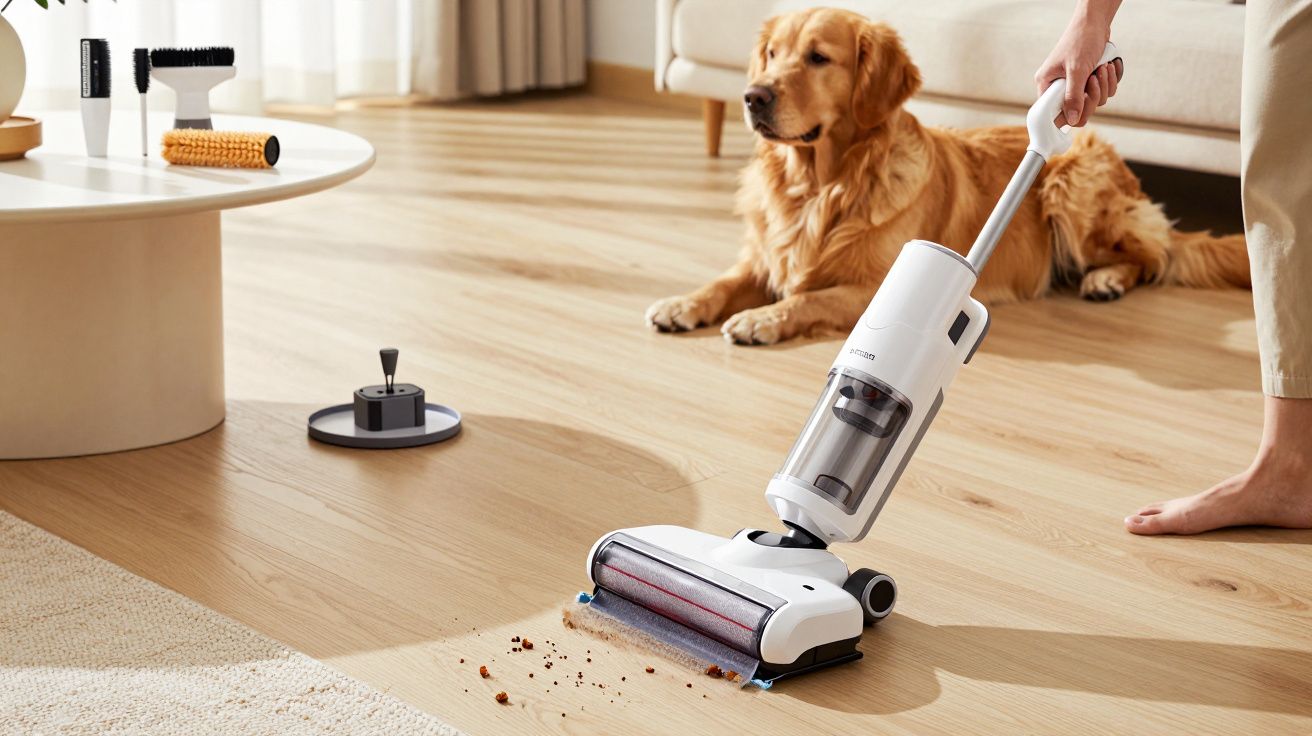
Xiaomi, best known for aggressively priced smartphones, is quietly building a serious home-appliance lineup. With the new Vacuum Cleaner G30 Max, the Chinese brand moves directly into Dyson’s territory, betting on strong suction, long battery life, and a deep accessory kit rather than flashy marketing.
A cordless cleaner built to challenge Dyson
The Vacuum Cleaner G30 Max replaces Xiaomi’s previous G20 Max and raises the bar in raw suction. Xiaomi rates the device at 280 air watts, a metric that combines airflow and suction pressure. The jump from the G20 Max’s 180 air watts is a substantial leap in cleaning capability, especially on thicker carpets and stubborn dirt.
This figure doesn’t just look good on paper. On Dyson’s side, the V12 Origin sits around 120 air watts, while the V15 Detect Absolute reaches about 240 air watts. Only Dyson’s latest V16 Piston Animal, launched in September, moves past Xiaomi’s new model at 315 air watts.
The G30 Max positions itself in the same performance range as higher-end Dyson models, while aiming to keep a mid-range price.
For buyers trying to decode the marketing, air watts shouldn’t be confused with motor wattage. High motor wattage doesn’t guarantee better cleaning. Air watts measure how much power actually reaches the floor through suction and airflow, which matters far more in day-to-day use.
Three cleaning modes and an intelligent dust sensor
Xiaomi structures the G30 Max’s performance around three cleaning modes. Turbo mode pushes the machine to maximum output for deep cleaning rugs, car mats, and entryways. It drains the battery faster but fits quick, targeted jobs where every pass matters.
For quieter, longer sessions, Eco mode cuts power significantly. On hard floors-which usually need less suction-Eco mode reduces energy use and noise while keeping visible dust under control.
The most notable change compared with earlier Xiaomi cordless models is the new Automatic mode. A built-in dust sensor estimates how dirty a surface is and adjusts suction in real time. This feature-still relatively uncommon in mid-range cordless vacuums-aims to reduce constant manual switching between power levels.
The dust sensor lets the G30 Max save battery on lightly soiled surfaces, ramping up only where dirt actually builds up.
For example, the vacuum can run at lower power along a hallway, then briefly increase suction over crumbs in the kitchen or a pet’s favorite spot on the rug. This kind of adaptive behavior matters in both small apartments and larger homes because it reduces wasted battery capacity.
Battery life, filtration, and dust bin: what changes in daily use
Under the hood, the G30 Max includes a 4,000 mAh battery. Xiaomi claims a 51% improvement in runtime over the older G11, reaching up to 70 minutes in Eco mode with the main motorized brush. Compared with the G20 Max’s 45 minutes, that extra half hour can be the difference between cleaning an apartment in one go or stopping mid-session.
In real use, the 70-minute figure will drop in Automatic or Turbo mode, but it still suggests enough runtime for a typical two- or three-bedroom home when power levels vary intelligently.
Filtration also gets an upgrade. The G30 Max uses a five-stage filtration system, with Xiaomi claiming 99.98% efficiency on fine particles. That means it aims to capture not only crumbs and dust bunnies, but also smaller particles like pollen and some allergens, instead of blowing them back into the air.
A five-stage filtration system helps trap very fine dust-an issue that often matters to allergy sufferers and pet owners.
The dust bin grows to 800 mL, up from 600 mL on the G20 Max. Fewer trips to the trash can can make a difference for homes with pets or children, where hair and debris build up quickly. The main brush adds a practical touch: a white LED light that reveals dust and hair on hard floors. Once people get used to vacuuming with a lit brush, they often notice what a regular vacuum leaves behind in darker corners.
A full accessory kit, with special attention to pet owners
Xiaomi ships the G30 Max with a packed set of tools designed for both large areas and awkward corners. The core package includes:
- Main electric floor brush with integrated LED light
- Small electric brush for mattresses, stairs, and upholstery
- Dedicated nozzle for sofas and cushions
- Wide 2-in-1 brush for shelves and furniture
- Narrow 2-in-1 brush for tight spaces and car interiors
- Pet grooming brush for collecting hair directly from the animal
- Wall-mounted charging dock and accessory holder
The grooming brush stands out. It connects to the vacuum and lets owners brush cats or dogs while suction captures loose hair before it spreads around the home-assuming the animal tolerates the noise and the feel of a brush connected to a vacuum wand.
For people without pets, the small electric brush will likely be the second most-used tool. It works well on mattresses, car seats, stair treads, and fabric headboards, where dust mites and crumbs tend to collect. The two 2-in-1 tools cover baseboards, window frames, keyboards, and other everyday problem areas.
How it compares with Dyson on price and positioning
Xiaomi hasn’t shared a final launch price or release date for the G30 Max. The previous generation provides a clear picture of Xiaomi’s strategy, though. The G20 Max currently sells for €299.99 in Europe. By comparison, Dyson’s V15 Detect Absolute launched around €799, and the new V16 Piston Animal at €849.
| Model | Approx. suction (air watts) | Launch price (Europe) |
|---|---|---|
| Xiaomi G20 Max | 180 | €299.99 |
| Xiaomi G30 Max | 280 | To be confirmed |
| Dyson V15 Detect Absolute | 240 | €799 |
| Dyson V16 Piston Animal | 315 | €849 |
If Xiaomi keeps pricing close to the G20 Max, the G30 Max could land at roughly one-third the price of Dyson’s top models while offering similar suction numbers to the V15 and approaching the V16. Even a modest price increase would still leave Xiaomi room to undercut Dyson significantly.
Aggressive pricing paired with high air-watt numbers puts real pressure on Dyson in the mid- to high-end cordless segment.
The real question for buyers will be build quality, durability, and after-sales support. Dyson has years of brand trust in these areas. Xiaomi, while experienced in consumer electronics, still needs to prove its cordless vacuums hold up after several years of regular use-especially in homes with pets and kids, where wear and tear is higher.
What “airflow” and “runtime” actually mean at home
Airflow and suction: more than a spec-sheet term
Vacuum marketing often blends several technical terms. Airflow, measured in liters per second or cubic meters per hour, refers to the volume of air the machine moves. Suction pressure, usually expressed in kilopascals, describes how strongly the vacuum pulls air. Air watts combine these factors to provide a more realistic picture of usable cleaning power.
In daily use, higher airflow helps pick up lighter debris like dust, hair, and crumbs across a wider area. Stronger suction pressure helps lift heavier particles embedded deep in carpet. Models like the G30 Max that push air watts higher tend to handle both situations better-assuming the floor-head design channels that power efficiently.
Battery runtime: why the headline number can mislead
“Runtime” for cordless vacuums refers to how long the machine runs on a single charge, but that headline number usually reflects the lowest power setting. A 70-minute claim typically assumes Eco mode on a hard floor with a non-motorized tool.
In reality, people mix modes. A more realistic G30 Max scenario might be 40 to 50 minutes combining Automatic and Eco for everyday cleaning, with much shorter Turbo bursts for carpets and spot cleaning. The advantage of Xiaomi’s dust sensor is exactly here: it tries to extend runtime dynamically instead of forcing the user to guess which mode fits each room.
How the G30 Max fits into a changing home-appliance market
Xiaomi’s move with the G30 Max reflects where the cordless vacuum market is headed. A few years ago, Dyson largely stood alone at the high-performance end, while competitors focused on cheaper, weaker models. Now, brands with strong electronics expertise-especially Chinese manufacturers-are bringing advanced sensors, efficient motors, and larger batteries into the category.
For consumers, this shift means more choice, but also more research. Features like dust detection, multi-stage filtration, and pet grooming tools target specific needs. Before buying, households can map priorities such as allergies, number of pets, floor types, storage space, and tolerance for noise. Xiaomi’s latest cleaner targets people who want Dyson-level suction without Dyson pricing-and who are willing to bet on a brand still building its reputation in home care.
A broader trend is also emerging: the convergence of smart gadgets and traditional appliances. The same company that sells connected phones and wearables now offers a data-driven vacuum that manages power based on dust levels. A next step could be deeper smart-home integration, usage stats, or reminders to clean filters and brushes to keep performance consistent over time.
For now, the G30 Max remains a promising, aggressively positioned cordless vacuum awaiting an official release date and final pricing. Its combination of strong air-watt performance, long claimed runtime, and a generous accessory kit puts clear pressure on established players-and gives shoppers another reason to rethink which brand should handle the weekly cleaning.





Comments
No comments yet. Be the first to comment!
Leave a Comment