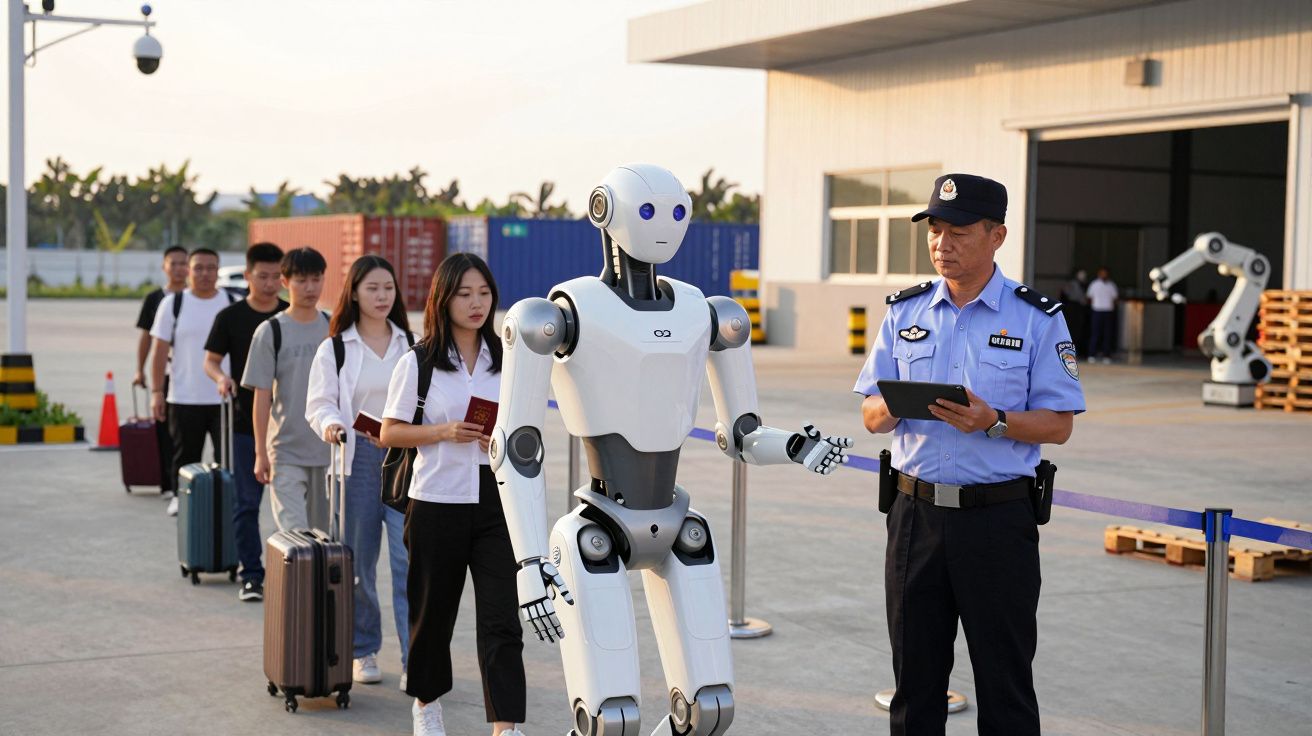
The experiment looks mundane at first glance: machines guiding lines and checking cargo. Behind it is a strategic bet on AI, security, and what borders will look like in the 2030s.
Why Fangchenggang, and why now
Fangchenggang, in the Guangxi region, faces Vietnam across a web of roads, ports, and customs checkpoints. Every day, trucks carrying electronics, textiles, and agricultural products roll through, alongside tour buses and day-trippers. Delays pile up during peak hours. Human officers juggle security, smuggling risks, and long lines of frustrated travelers.
Chinese authorities have chosen this crossing as a real-world test bed for humanoid robots from Ubtech Robotics, a Shenzhen-based company known for its Walker line of bipedal machines. The deal, worth about €37 million, brings adult-sized robots into one of the country’s busiest land gateways to Southeast Asia.
The border is turning into a proving ground: if humanoid robots can handle this chaotic environment, they can handle almost anything.
The timing lines up with several Chinese priorities at once: streamlining trade with ASEAN partners, promoting domestic tech champions, and tightening control over borders where legal commerce and illegal flows overlap.
Meet the Walker S2 robots
The Walker S2 units arriving in Fangchenggang stand about as tall as an adult. They walk on two legs, grasp objects with articulated hands, and carry an array of cameras, depth sensors, and microphones. Their onboard software combines vision, speech recognition, and navigation algorithms tuned for crowded indoor spaces.
- Height and build: Similar to an average adult, able to move through standard doors and corridors
- Mobility: Dynamic walking, turning in tight spaces, climbing gentle ramps
- Sensing: Multiple cameras, lidar-style depth sensing, microphones, and touch sensors
- Interaction: Screens, speakers, and scripted dialogs for basic questions
- Connectivity: Constant link to command centers for data and remote supervision
Ubtech has long presented these robots as general-purpose helpers for offices, malls, and airports. The Fangchenggang deployment stretches that vision into a more sensitive arena, where mistakes carry political and security risks.
The new division of labor at the border
Chinese officials do not want the robots to replace officers outright. They want them to absorb thousands of repetitive, low-risk tasks that currently drain staff time and patience.
Guiding travelers and managing lines
In passenger halls, Walker S2 units will stand near checkpoints, ticket counters, and luggage scanners. They will manage the flow of people, directing travelers into the right lines and giving simple instructions in Mandarin and, when needed, Vietnamese or English.
Instead of repeating “stand behind the yellow line” a hundred times a day, officers can let a robot do the talking while they focus on suspicious cases.
Robots will answer basic questions: which lane to use, what documents to show, where to pay fees, and how to declare goods. Their scripts can be updated with new rules or health requirements, such as temperature checks or quarantine forms if another pandemic-style wave appears.
Authorities also expect a psychological effect. A patrolling humanoid serves as a visible reminder of surveillance without feeling as threatening as additional armed guards. The line between service and deterrence becomes thinner-and carefully managed.
Patrolling warehouses and freight yards
In freight zones, other Walker S2 units move through container stacks and parking areas. They scan ID labels, read digital seals, and compare what they see with electronic manifests. If a container appears to have been tampered with, the robot flags it for a human inspection team.
These patrols generate a steady stream of video and sensor data sent to a control room, where analytics software looks for patterns: unusual traffic at odd hours, repeated use of certain bays, or suspicious clusters of vehicles.
| Robot task | Main goal | Human officer’s role |
|---|---|---|
| Line management | Reduce bottlenecks and confusion | Handle disputes and unusual cases |
| Answering standard questions | Free officers from routine explanations | Provide nuanced guidance and handle complaints |
| Freight area patrols | Spot anomalies in cargo and vehicle flows | Conduct detailed inspections when alerted |
| Presence in waiting areas | Signal constant monitoring and provide basic help | Step in during conflicts or emergencies |
A stress test for Ubtech’s broader ambitions
Ubtech executives see Fangchenggang as much more than a single contract. It functions as a high-pressure demonstration to government buyers from across China, and to foreign delegations watching how Beijing applies humanoid robotics to border control.
If these robots survive crowded halls, impatient drivers, and tropical humidity, they gain credibility for airports, seaports, and even city streets.
The company needs real deployment cases to stand out in a crowded Chinese AI and robotics field. Funding flows toward firms that can show working products rather than lab prototypes. A border crossing-with its mix of logistics, policing, and public service-offers the kind of complexity investors like to see mastered.
The move also aligns with Beijing’s broader push to anchor industrial policy in practical, high-visibility pilots. Factories, ports, and train stations have become showcases for domestic automation. A frontier city on the Vietnam border adds a geopolitical layer that makes the project even more symbolic.
Security, surveillance, and public reaction
For travelers, the presence of humanoid robots may range from novelty to discomfort. Some people will gladly ask a machine for directions rather than struggle in a second language with an officer. Others will feel uneasy under a gaze that never blinks and constantly records.
Chinese authorities rarely hide the surveillance angle. Each robot effectively acts as a mobile sensor node in a larger security network. Cameras watch faces and behavior. Microphones pick up tone and keywords. Logs capture where people gather and how long they stay.
Local acceptance will matter for scaling. If lines move faster and interactions stay polite, residents and cross-border traders will likely tolerate the extra monitoring. If the robots malfunction, misread gestures, or clog walkways, irritation will spread quickly on social media in China and Vietnam.
Risks and unintended consequences
Deploying humanoid robots in such a sensitive role carries clear risks. Software bugs can send passengers to the wrong place. Network outages can stall operations if the machines depend too heavily on remote servers. Overconfidence in automated checks can create blind spots for smugglers who adapt faster than the AI models.
Automation at borders tends to shift, not remove, human work: officers spend more time auditing algorithms and less time stamping passports.
There is also a diplomatic angle. High-tech surveillance at the China–Vietnam border may concern Hanoi if it appears to target specific groups or trade flows. At the same time, success in Fangchenggang could tempt Vietnam and other neighbors to adopt similar systems, deepening reliance on Chinese technology suppliers.
What this signals for future borders
The Fangchenggang project fits into a global shift in which borders become automated filters. Airports already rely on biometric gates, risk-scoring software, and AI-assisted screening of baggage images. Humanoid robots add a more visible, almost theatrical face to this transformation.
Instead of kiosks and fixed cameras, travelers encounter mobile machines that speak, gesture, and reposition themselves as crowds build. In the short term, they will handle narrow roles. Over time, their software may integrate with facial recognition databases, customs declarations, and health records, creating a much denser grid of data around cross-border movement.
For policymakers outside China, Fangchenggang offers a live case study. They can watch how maintenance costs evolve, how failure rates look after monsoon seasons, and how public attitudes change after the early novelty fades. Those observations will shape whether similar deployments appear in Europe, North America, or other parts of Asia.
How to interpret the hype around humanoid border guards
Humanoid robots draw attention because they look like people, but their real value lies in software and systems integration. A simpler wheeled robot or kiosk can already handle many of the same tasks. The walking form factor mainly helps in environments not designed for machines: stairs, crowded lobbies, narrow service corridors.
When you strip away the human-like shell, the Fangchenggang trial tests three things:
- Whether AI systems can reliably interpret messy, real-world human behavior at scale
- Whether border agencies gain measurable efficiency without losing accuracy or fairness
- Whether societies accept constant, embodied surveillance in public transit spaces
For now, Fangchenggang is just one crossing along a long border. Yet the choices made there about data retention, limits on machine decision-making, and human override will echo far beyond Guangxi. The experiment does not just shape how trucks and tourists move between China and Vietnam. It becomes part of a broader negotiation about how much power we hand to machines when we stand in line, hand over our papers, and wait for a gate to open.





Comments
No comments yet. Be the first to comment!
Leave a Comment