Wasn’t it January just yesterday? Now it’s almost summer, the year sliced into neat little blocks of meetings and deadlines. Your kid has grown out of a pair of shoes in what feels like a long weekend. Your parents suddenly look older in the photos from last Christmas.
Yet when you think back to being ten, the school year felt endless. A two-week vacation was a world in itself. Waiting for your birthday was torture. Somewhere along the way, the clock didn’t change, but your sense of it did.
The strange part is that nothing on the wall clock is lying to you. Your brain is.
Why Your Brain “Compresses” Time as You Age
Time doesn’t actually speed up with age, of course. What changes is how your brain slices up reality. When you’re young, almost everything is new: first bike, first sleepover, first heartbreak. New experiences demand more attention, and your brain writes them down in rich detail.
As the years stack up, more of your days look similar. Your brain starts running on pattern mode. It recognizes what’s happening and quietly says, “Got it, seen this.” Less attention, fewer rich memories, and the months begin to blur together like a badly edited montage.
That blur is what makes five years at 40 feel shorter than one year at 15.
Think about a first day in a new city. You step out of the train station and everything hits you at once: smells, sounds, the way people cross the street, the shape of the buildings. Your brain is on high alert, trying to map this unknown world. At night, you crawl into bed with the sense that the day was huge.
Now compare that with a regular Tuesday in a familiar office. Same commute, same coffee, same faces. At the end of the day, you might struggle to recall anything that stands out. The actual hours were equal, but one day is packed with mental “frames,” the other is a low-resolution file.
One study on vacation memories found that people consistently overestimated how long novel, intense trips lasted, while underestimating routine weeks at home. Your brain counts “moments,” not minutes.
Neuroscientists talk about this in terms of information processing. New experiences flood the hippocampus and prefrontal cortex with sensory data. Your brain carves out fresh neural pathways, expanding your sense of time because there’s simply more to store.
Routine days reuse existing pathways. They’re efficient, almost like hitting “copy-paste” on an old document. Efficiency is great for survival, less great for the subjective stretch of time. So as your life fills up with habits, your brain needs fewer mental “snapshots” to represent a day or a year.
The result: your internal timeline gets compressed, especially when you look backward. The years seem to stack like thin sheets instead of thick chapters.
How to “Slow Down” Time With Intentional Novelty
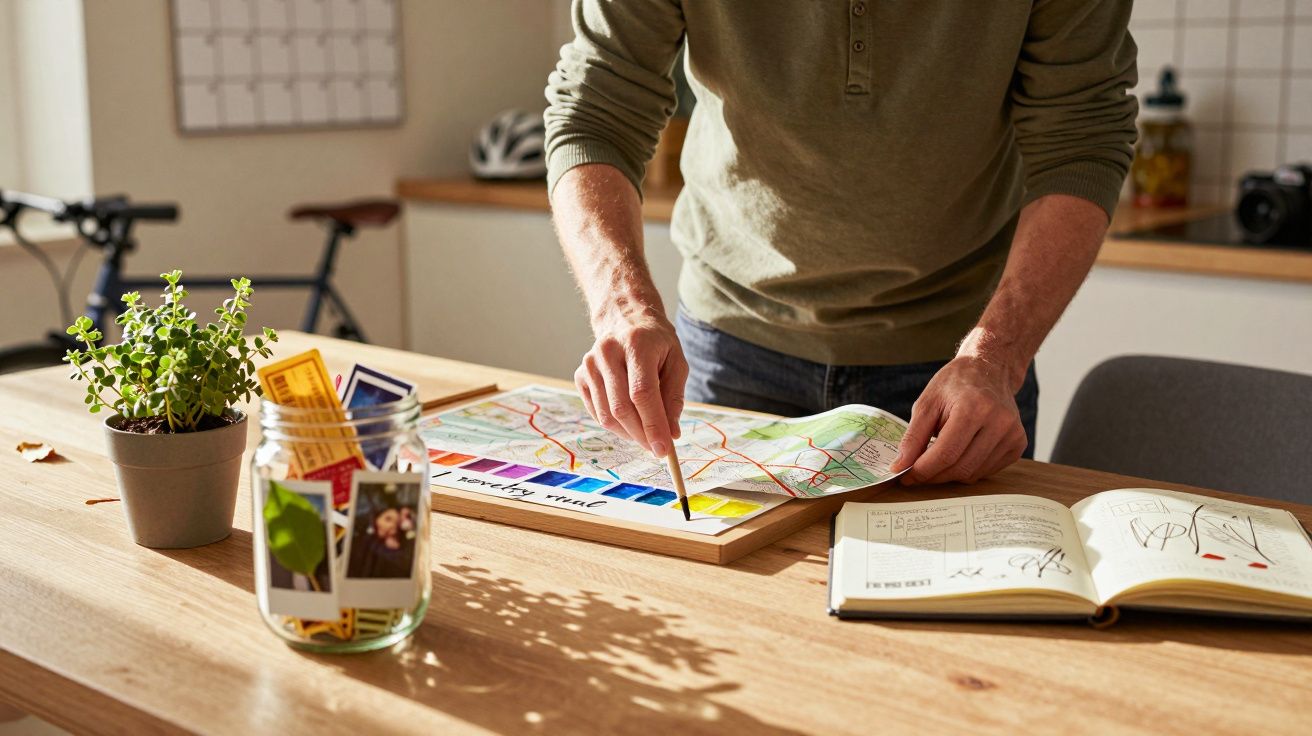
The closest thing we have to a pause button on this feeling is novelty. New experiences, even small ones, force your brain out of autopilot and back into detailed recording. You don’t need to move to another country. You can start with micro-changes.
Walk a different route to work. Shower in the dark once in a while. Swap your usual supermarket for another across town. Eat breakfast outside instead of at your desk. These shifts sound trivial, yet they jolt your attention awake. Your brain thinks, “Oh, this is different,” and starts taking notes again.
Each of those notes becomes a hook your memory can hang time on.
Souvenirs help anchor those hooks-not just objects, but deliberate traces. A short voice memo on your phone after a meaningful day. A single photo per day, not fifty. A sentence scribbled in a notebook: where you were, who was there, what you noticed in the air.
Let’s be honest: nobody really does this every day. Life gets loud, and even the act of “capturing” can become another routine. So pick moments that already feel charged: the awkward dinner, the unexpected walk in the rain, the quiet train ride after bad news.
Years later, those sparse, honest traces will stretch that day back out, making it feel full again instead of lost.
There’s a psychological trick at play: what feels fast while you’re living it can feel long in hindsight if it’s dense with events. Intense workdays, for example, often feel like they vanish in real time. Then when you look back at everything you did, the memory is surprisingly long.
That’s because your “experiencing self” and your “remembering self” don’t use the same clocks. The experiencing self cares about comfort and predictability. The remembering self cares about stories, peaks, and turning points. Long stretches of comfort produce thin stories.
So if you want your life to feel longer when you look back, you need to feed the remembering self with fresh scenes and emotional beats, not just safe routines. It’s a quiet negotiation with your own brain.
Everyday Rituals to Stretch Your Sense of Time
One powerful method is what some psychologists call “time confetti” in reverse. Instead of scattering your attention into tiny, forgettable fragments, you bundle your awareness into short, vivid rituals. Five minutes is enough.
Pick one part of your day and treat it like a mini-ceremony. Making coffee with full attention. Listening to a single song, eyes closed, no phone. Standing at your window at night and scanning the lit windows across the street. Do it slowly, as if you were filming the scene for someone else.
Those five minutes can become a landmark in an otherwise generic day.
Another simple gesture: name your days. Not out loud, not in a planner covered with stickers-just in your head or as a short note.
- “The day the train stopped in the tunnel.”
- “The day my boss apologized.”
- “The day with the orange sunset over the parking lot.”
On a bad week, this might feel forced. On a good week, it becomes addictive. On a very ordinary week, it rescues time that would have slipped through the cracks. On a human level, this is how we’ve always told stories: by giving days a title.
Over months, those titles quietly fight the sensation that “the last three years just disappeared.”
One more habit: pause at natural transitions. Before entering your home, your office, or a friend’s place, stop for two breaths. Notice one detail: a smell, a sound, the temperature of the air. It takes less than ten seconds, and it pins the scene to your memory.
“Attention is the rarest and purest form of generosity.”
That line from Simone Weil doesn’t just apply to other people. It applies to your own life. Where your attention goes, your sense of time follows.
- Choose one daily ritual to do slowly and consciously.
- Add one small novelty to your week (route, coffee shop, hobby).
- Write a five-word title for the day before bed.
None of this stops the clock. It just thickens the pages.
Rethinking “Lost Years” and the Way We Talk About Time
There’s a quiet grief in hearing someone say, “The last decade went by in a flash.” It can sound like a confession, or even a complaint against your own brain. Yet that feeling is also a clue that something in the way we structure life doesn’t quite match how we experience it.
We pack our calendars, stack responsibilities, automate as much as we can. The reward is supposed to be efficiency. The side effect is that whole seasons of your life become so optimized that memory has nothing to grab. Days melt into each other like snow on warm pavement.
On a collective level, that’s a cultural choice, not a law of physics.
On a more intimate level, it raises awkward questions. If time feels like it’s accelerating, what do you want to slow down for? Which relationships do you want to make “thicker” in memory? Which projects deserve to be vivid chapters instead of faint lines on a resume?
We’ve all had that moment where, looking at an old photo, we realize we barely remember that version of ourselves. That jolt is uncomfortable, but it’s also an invitation-an invitation to write the next months differently, even in small strokes.
So maybe the real shift isn’t about hacking time at all. It’s about renegotiating the kinds of days you’re willing to live on autopilot. The brain will always compress what it can. Your job is to complicate its work with experiences that matter enough to resist the blur.
| Key Point | Detail | Why It Matters to You |
|---|---|---|
| The brain compresses time | With age, more routines and fewer novel experiences reduce the number of detailed memories. | Understand why the years can feel like they pass faster after your 30s or 40s. |
| Novelty slows perceived time | Small new experiences force the brain to pay attention and create new reference points. | Find practical ways to make your weeks feel less blurry. |
| Rituals and “traces” strengthen memory | Mindful rituals, day titles, notes, and a few photos thicken memory. | Turn “normal” days into richer chapters you’ll remember later. |
FAQ
- Why does time feel slower in childhood? Because almost everything is new, your brain records experiences in high detail, creating many memory “markers” that make periods feel longer in hindsight.
- Can I really change how fast time feels? You can’t touch the clock, but by adding novelty, attention, and emotional intensity, you can change your subjective sense of how full a year feels.
- Does routine always make time fly? Routine tends to blur days together, yet meaningful routines done consciously-like a nightly walk or shared meal-can still create strong, time-stretching memories.
- Why do stressful periods feel long while they’re happening? Stress heightens vigilance and makes you monitor each moment closely, so time drags in the moment, even if those weeks later compress into a single “hard phase.”
- Is it too late to “slow down” time in my 40s, 50s, or beyond? No. The brain remains plastic throughout life; new skills, places, people, and rituals can still carve vivid, memorable chapters at any age.




Comments
No comments yet. Be the first to comment!
Leave a Comment