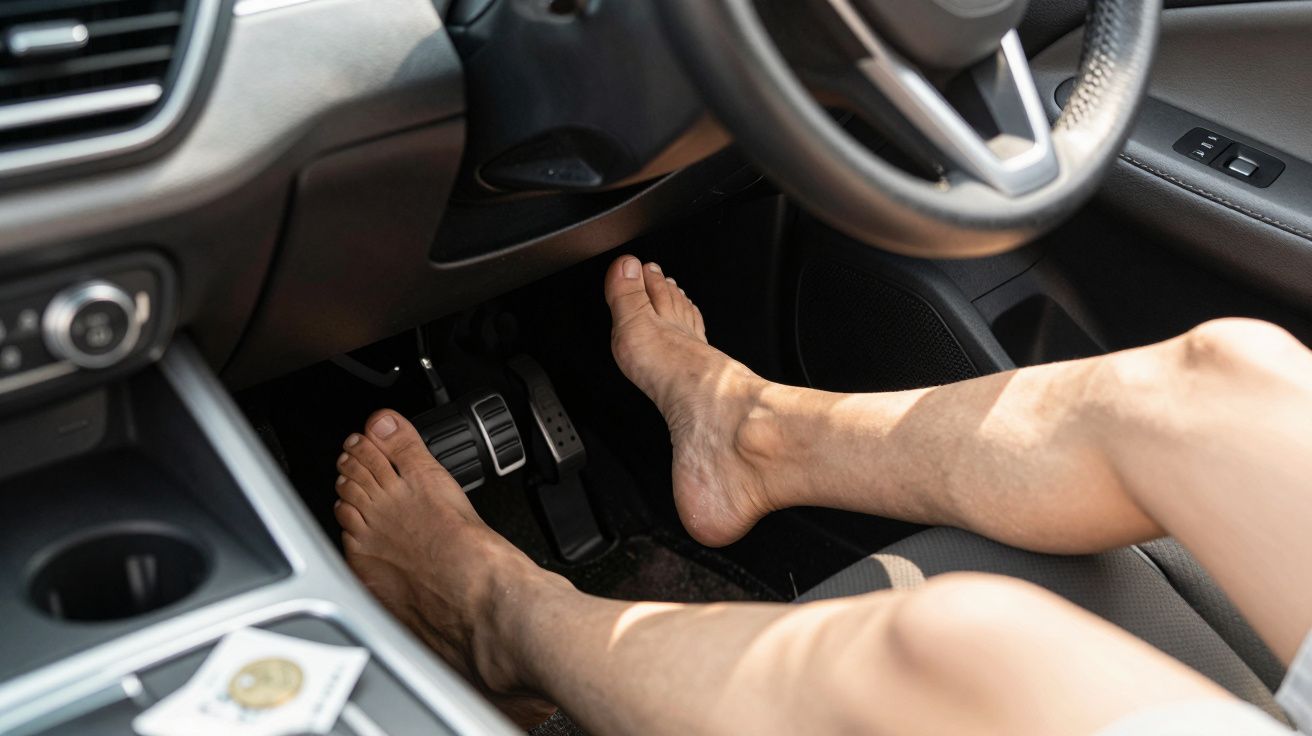
You could see the driver’s right foot just resting on the pedal, ankle loose, the car half-awake. When the car finally crept forward, there was a faint squeak you almost felt more than heard. A tired sound. A sound of parts that have had enough.
Most drivers never think about where their feet spend their time in the car. As long as it moves, it’s fine, right? Yet that tiny habit of resting your foot “just there” can quietly grind away at components you’d rather not pay to replace. A small comfort, a big bill. The kind you don’t see coming.
There’s a spot that mechanics recognize instantly. And they can almost tell your driving style just by looking at it.
Where drivers rest their foot - and what it secretly destroys
Spend five minutes at any busy intersection and you’ll spot it. Drivers with their right foot lightly touching the brake pedal, even when they’re not actually braking. To them, it feels safe, like they’re ready for anything. To the car, it’s a constant, invisible demand for work.
That tiny pressure, barely noticeable from the seat, is enough to make brake pads kiss the rotors again and again. Not a full clamp-just a soft, endless rub. On a dry day you might not notice a thing. In the rain, you might catch a faint burning smell near the wheels and wonder where it comes from.
One London mechanic told me about a delivery driver who came in swearing his “new van was cursed.” He was on his third set of front pads in under a year. The van had done less than 25,000 miles. No towing. No mountain roads. Just city traffic and endless starts and stops.
They took him out for a test drive. Within two minutes, the culprit showed up. His right foot was parked permanently half on the brake, half ready to accelerate. He thought he was being reactive and careful. In reality, the brake lights were flickering like a Christmas tree, and the pads were gently scrubbing the rotors the whole time.
When they showed him the wear pattern, he didn’t believe it at first. The outer edges of the pads were glazed and uneven, as if smoothed by sandpaper. Someone did the math on the cost: three sets of pads and rotors versus one small change in posture. The room went quiet.
Mechanics see the same story over and over again. Resting your foot lightly on the brake pedal doesn’t feel like braking, yet the hydraulic system doesn’t care what you feel. Pressure is pressure. A slight contact between pad and rotor creates heat, and heat is what wears material away.
Over thousands of miles, that habit means you replace pads years earlier than you should. Rotors can warp or develop grooves. Calipers work overtime, seals get cooked, brake fluid bakes. Drivers complain of “spongy” or “grabby” brakes, not realizing it started with where their foot liked to relax.
There’s another part of the car that suffers too: the clutch. Drivers who rest their foot on the clutch pedal keep the release bearing constantly loaded. The bearing spins when it shouldn’t, the clutch never fully engages, friction builds. You lose performance and money at the same time.
The simple foot habits that save your brakes, clutch, and wallet
There’s a small bit of plastic or rubber most drivers ignore: the dead pedal, that raised footrest to the left of the clutch in many cars. That’s where your left foot belongs whenever you’re not changing gears. Not hovering, not grazing the clutch, but properly parked on that rest.
Doing this keeps the clutch pedal fully released, the release bearing relaxed, and the clutch plates fully engaged. Less slip, less heat, less wear. It also braces your body, especially on long drives. Your posture improves, your legs don’t tire as quickly, and your inputs on the other pedals become cleaner and more precise.
For the right foot, the rule is even simpler. When you’re not slowing down, your foot should be fully on the accelerator or fully on the floor, just in front of the brake. No half-resting on the pedal. No “just in case” pressure. When you actually brake, commit. Then come off it completely.
The most common mistake looks innocent. You’re crawling in slow traffic, barely moving. Your foot hovers on the brake and you caress it instead of using it firmly and then releasing. That keeps the pads in a half-engaged limbo. Everything warms up for nothing.
On the highway, another habit creeps in. Some drivers leave the cruise control on and rest a foot lightly on the brake “just in case.” The car interprets it as real braking input. The system disengages, the pads drag, fuel economy drops, and the brake lights annoy everyone behind.
On a steep hill, the temptation is huge to hold the car on the brake pedal at every stop. It feels in control. Yet for automatic cars especially, that’s tough on the brakes and transmission. Using the parking brake or auto-hold function gives the system a breather. Let’s be honest: nobody really does that every day. But when you remember, the difference adds up.
“When I see blue-tinted rotors and pads worn to the metal at 30,000 miles, I don’t think bad luck. I think driver habit,” says Marc, a French mechanic who’s been in the trade for twenty years. “The car is just obeying what your foot is saying, even if you don’t realize you’re speaking.”
On a workshop wall in Lyon, there’s a hand-written checklist taped next to the coffee machine. It’s aimed at customers, not staff. The message is blunt, but oddly kind. It reads like advice from an older cousin who’s wrecked a few cars and learned the hard way.
- Rest your left foot on the dead pedal, not the clutch
- Keep your right foot fully off the brake unless you’re slowing down
- On hills, use the parking brake or auto-hold at red lights
- Watch your brake lights in store windows to spot if you’re riding the pedal
- If you smell burning near the wheels, change your foot habits before you change your pads
What your feet say about you on the road
On a quiet evening, watch your reflection in the rear window of the car ahead as you roll through town. Look at your own brake lights flashing in storefront glass. Do they blink constantly in tiny bursts, or only when you’re genuinely slowing down? That small pattern tells the story of how hard your car is working behind your back.
We tend to see brakes and clutches as “the car’s problem,” something buried under metal, oil, and heat. Yet the real conversation is between your shoes and those hidden parts. Constant tiny pressure equals constant tiny damage. No drama, just slow erosion. The kind you only notice when a mechanic calls you into the shop with a serious face.
On a human level, this is about more than money. It’s about the weird comfort of bad habits. We rest our foot where it feels cozy, or “ready,” without thinking that someone, one day, will put your worn parts on a bench and read your driving style like a diary. On a hot day, when the bill is higher than you’d planned, that diary suddenly feels very personal.
| Key point | Details | Why it matters to readers |
|---|---|---|
| Riding the brake pedal | Keeping your right foot resting lightly on the brake makes pads touch the rotors constantly, creating heat and premature wear. | Means changing pads and rotors far earlier than expected, with repair bills that can jump from $150 to $500+ on modern cars. |
| Resting on the clutch | Parking your left foot on the clutch pedal loads the release bearing and stops the clutch from fully engaging. | Shortens clutch life, which often costs $700–$1,500 to replace when labor and parts are included. |
| Using the dead pedal | Putting your left foot on the dead pedal supports your leg and keeps you from accidentally touching the clutch. | Reduces fatigue on long drives, improves control, and quietly extends the life of expensive drivetrain parts. |
FAQ
- Is it really bad to rest my foot lightly on the brake? Yes. Even a small pressure can keep the pads in contact with the rotors, generating heat and wear that you don’t notice until the parts are already worn out.
- How do I know if I’m riding the brakes without realizing it? Ask someone to follow you and watch your brake lights, or look at your reflection in parked cars. If your lights flicker often while your speed is steady, your foot is doing too much.
- Can this habit affect fuel consumption? Constant light braking wastes energy as heat, so the engine has to work harder to maintain speed. Over time, that can mean several extra gallons of fuel on long trips.
- Is using the dead pedal really that useful? Yes, especially in manual-transmission cars. It supports your leg, prevents clutch riding, and gives you a more stable driving position, which also helps in emergency maneuvers.
- What about automatics-can I still cause premature wear with my feet? Absolutely. Resting on the brake overheats pads and rotors, and using both feet (one on brake, one on accelerator) can stress the entire braking system.
- How long should brake pads last with good foot habits? It depends on the car and driving style, but many everyday drivers see 25,000–50,000 miles from a set of pads when they’re not riding the pedal.






Comments
No comments yet. Be the first to comment!
Leave a Comment