But step closer and the air changes. Bees hum low over white blossoms, a wren darts in and out of the tangle, and the soil under your boots feels soft instead of dead and dusty. Somewhere behind you, a tractor passes with a dull roar, and then the silence returns-thick and alive.
The farmer standing beside this hedge isn’t talking about yield or subsidies. He’s pointing out beetles, fungi, tiny burrows in the bank. Ten years ago, this boundary was bare wire and wind. Now it’s a corridor. A shelter. A slow revolution running along the edges of his land.
Stretch that picture across a continent, and you start to see something big-something quietly radical.
From Bare Fields to Living Corridors
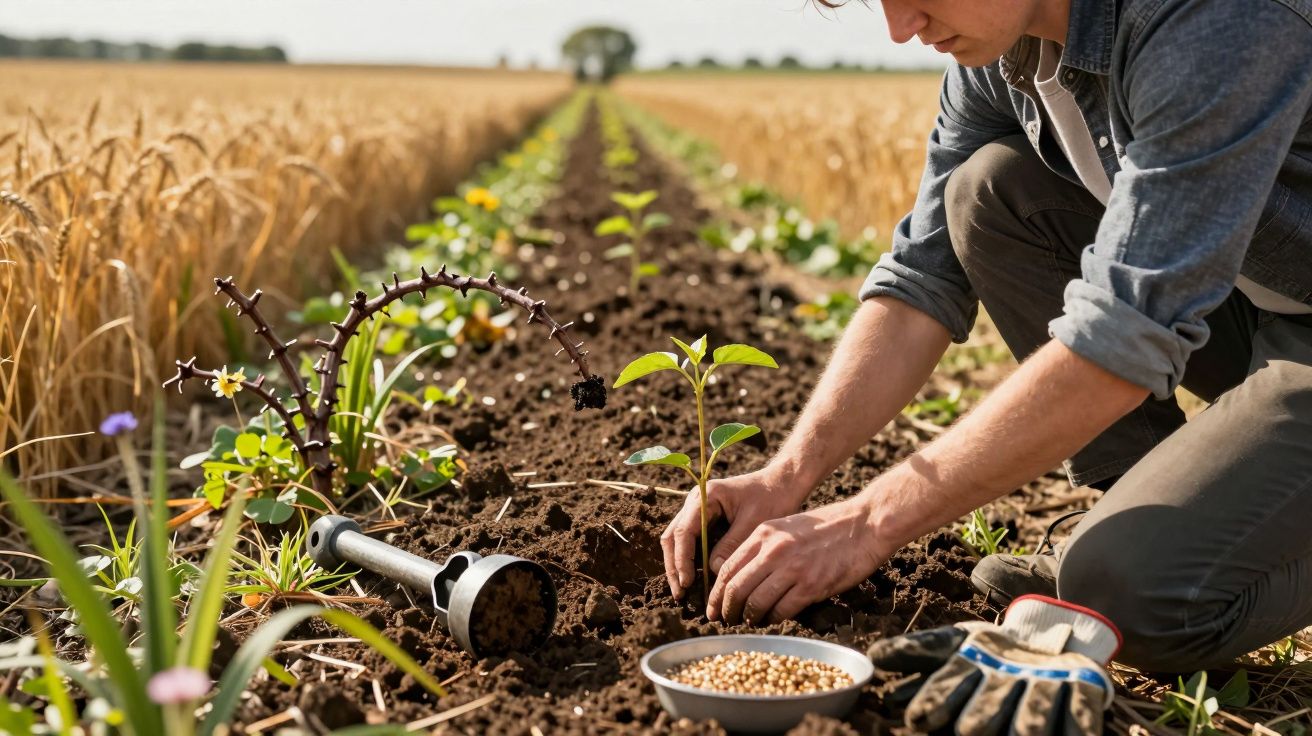
On a damp spring morning in northern France, a line of volunteers moves along a field like a strange, muddy conveyor belt. One person digs, another sets a young hawthorn, another presses the soil down with a boot. They’re chatty, a little cold, half laughing, half cursing the sticky clay. In an hour, sixty-five feet of hedgerow appears where there was nothing but wind and runoff.
Now multiply that scene by thousands. Across Europe and beyond, more than 90,000 kilometers of hedgerows have been replanted in recent years. That’s roughly the distance of circling Earth twice along the equator-not with concrete or fences, but with living green veins. Each new stretch becomes a small climate buffer, a wildlife refuge, and a shield against eroding soil.
The scale feels abstract until you remember that every kilometer begins with a hole in the ground and a sapling in someone’s hand.
In southwest England, one study followed an old farm that had ripped out hedges in the 1970s to “modernize.” Yields jumped for a while, then leveled off as soils thinned and pests spread faster across open fields. When the family started replanting hedgerows in the 2000s-a few hundred meters each winter-the change surprised them. Birds came back first, then bats. Within five years, pest damage dropped, and they reduced pesticide use.
Soil tests told a quieter story. Under the hedges, organic matter increased. Earthworm counts doubled. Rain that once sheeted off the land began soaking in along those dense, root-laced banks. Nothing flashy-just year after year of small gains, stitched along the margins of fields that looked “productive” but were steadily losing life.
That arc is repeating across landscapes that pushed industrial farming nearly to the limit. Hedgerows aren’t nostalgia; they’re insurance.
Zoom out from a single farm and the logic of hedgerows becomes almost embarrassingly clear. A bare field is a racetrack for wind and water. Rain hits hard, lifts soil, and carries it downhill. In summer, hot air scours the ground, stripping the last moisture from exposed earth. Wildlife has nowhere to hide, so pests dominate because their predators have vanished along with the cover.
A hedgerow interrupts all of that. Its roots bind the soil and slow runoff. Its uneven shape breaks the wind, creating calmer pockets where moisture lingers. Leaves and twigs fall, feeding fungi and microorganisms that build soil structure from the top down. Birds, beetles, spiders, small mammals-they use it as a highway and a home, quietly rebalancing who eats whom in the surrounding fields.
So when you hear “90,000 kilometers of hedgerows,” you’re really hearing about 90,000 kilometers of small climate regulators and biodiversity shelters stitched back into a torn-up countryside.
How Hedgerows Are Rebuilt-and How Not to Ruin Them
The basic idea sounds almost too simple: dig a line, plant a mix of native shrubs and trees, protect them for a few years, then let nature take over. On the ground, though, the most successful projects follow a kind of quiet craft. Farmers and restoration teams choose species already adapted to the local climate: hawthorn, blackthorn, hazel, dog rose, field maple. They plant densely, sometimes in three or four rows, to build a solid backbone instead of a weak, patchy line.
Spacing matters. Too tight and the hedge competes with itself; too wide and gaps open up that let wind cut through. So they aim for the sweet spot where branches knit together, forming both a barrier and a habitat. Mulch suppresses weeds in the early years, while low fencing protects the hedge from livestock or overeager tractor passes. It looks fussy at first-then one day it disappears into green, as if it had always been there.
People love the idea of hedgerows, then often stumble over the same mistakes once the work begins. Some plant a single species along long stretches because it’s cheaper and easier to manage. It can look tidy, but it makes the hedge more vulnerable to disease and offers fewer niches for wildlife. Others trim new hedges into hard, sterile boxes every year-more like living fences than living ecosystems.
There’s also the timing problem. Cutting hedges during peak bird nesting season wipes out broods in a single pass. Many countries now encourage or require winter cutting, when birds aren’t nesting and berries have mostly been eaten. And then there’s the hidden issue: letting hedges get too thin at the base. That gap is an open door for erosion and wind. Healthy hedges are dense from the ground up, not “lollipop” trees hovering over bare banks.
On a farm in Brittany, a hedge specialist summed it up for a group of new landowners in one clean sentence:
“Treat a hedge like a line of wild neighbors, not a piece of garden furniture.”
That mindset changes everything. You start leaving dead wood in place for insects. You accept a little mess at the edges because that’s where the richest life happens. You cut less often and with more purpose, using traditional methods like laying-partially cutting and bending stems to thicken the base-instead of shaving the top flat every year.
For anyone who wants to support this shift, a few simple lenses help:
- Diversity first - mixed native species beat uniform hedges for resilience and wildlife.
- Height and depth matter - tall, multi-row hedges protect soil and provide real shelter.
- Gentle management - less frequent, smarter cutting preserves nests, berries, and structure.
- Think corridors - every hedge is more powerful when it connects to another habitat patch.
Let’s be honest: nobody does this perfectly every day. But each time someone chooses the wilder, slightly untidy version over the flawless line, they’re backing a future that can actually breathe.
A Quiet Network That Might Change How We Farm
Stand at the edge of one of these replanted hedgerows and follow it with your eyes. It runs to a small stand of oaks, then to another hedge, then to a damp hollow that sometimes fills into a seasonal pond. Suddenly the farm stops looking like a set of rectangles and starts looking like a web. Those connections are where climate resilience slips in.
Farmers who once saw hedges as a nuisance are starting to talk about them as allies. Some notice fewer crops flattened by wind. Others see water sticking around longer into dry spells, stored in the shaded soils beneath the hedge line. A few are blunt: without these buffers, they say, the next drought or downpour would have hit far harder. On bad-weather years, hedges can be the difference between “a rough season” and serious loss.
There’s an emotional undercurrent too, rarely mentioned in reports. On a foggy evening, walking along a hedge alive with unseen rustling feels different than crossing a bare, sprayed field. You feel like part of a place, not just someone moving through a production unit. On a global scale, that might sound small. On a human scale, it’s huge.
More than 90,000 kilometers of replanted hedgerows are already reshaping soil, sheltering wildlife, and helping landscapes cope with harsher weather. The number will grow, and with it the questions: How far can this approach go in intensive farming regions? Who pays for the quiet work at the margins? What stories will children tell about these once-forgotten green lines when they’re adults walking the same paths?
Each new hedge is a bet on a slower, richer way of using land. Some will fail, some will be cut too hard, some will thrive beyond anyone’s expectations. But they all say the same thing: life along the edges isn’t a side issue-it’s the main plot. The next time you pass a scruffy line of shrubs and trees between fields, it might be worth stopping for a minute and just listening.
| Key Point | Detail | Why It Matters to Readers |
|---|---|---|
| Hedgerows rebuild soil | Roots stabilize banks, organic matter increases, and water infiltrates instead of running off | Helps explain how simple landscape features protect food security |
| 90,000+ km replanted | A massive network across farms creating wildlife corridors and climate buffers | Shows this is a real, large-scale shift-not just a few “green” pilot projects |
| Management matters | Mixed species, gentle cutting, and corridor thinking turn fences into ecosystems | Offers practical levers for landowners, voters, and consumers who want impact |
FAQ
- Where are most of these new hedgerows being planted? Much of the current boom is in Europe-especially France, the UK, Ireland, Belgium, and Germany-often supported by public funding, though similar projects are spreading in North America and parts of Asia.
- Do hedgerows reduce crop yields by taking up space? They take up a little land along field edges, but many farms see stable or even improved net yields over time thanks to better soil health, less erosion, and lower pest pressure.
- How long does it take for a new hedgerow to become useful for wildlife? Birds and insects begin using it within a couple of years, but the full structure-dense cover, cavities, and rich soil life-usually develops over 10–15 years.
- Can small landowners or gardeners use this approach? Yes. Planting a mixed native hedge instead of a sterile fence, even on a small lot, creates shelter, food, and shade-and links up with nearby green patches.
- Are hedgerows really relevant to climate change? They store carbon in woody biomass and soils, but their biggest climate value is buffering extremes-slowing floods, reducing wind damage, and helping landscapes hold onto water.






Comments
No comments yet. Be the first to comment!
Leave a Comment