Far from any coastline, a Japanese research ship is quietly testing something that could redraw global tech supply chains.
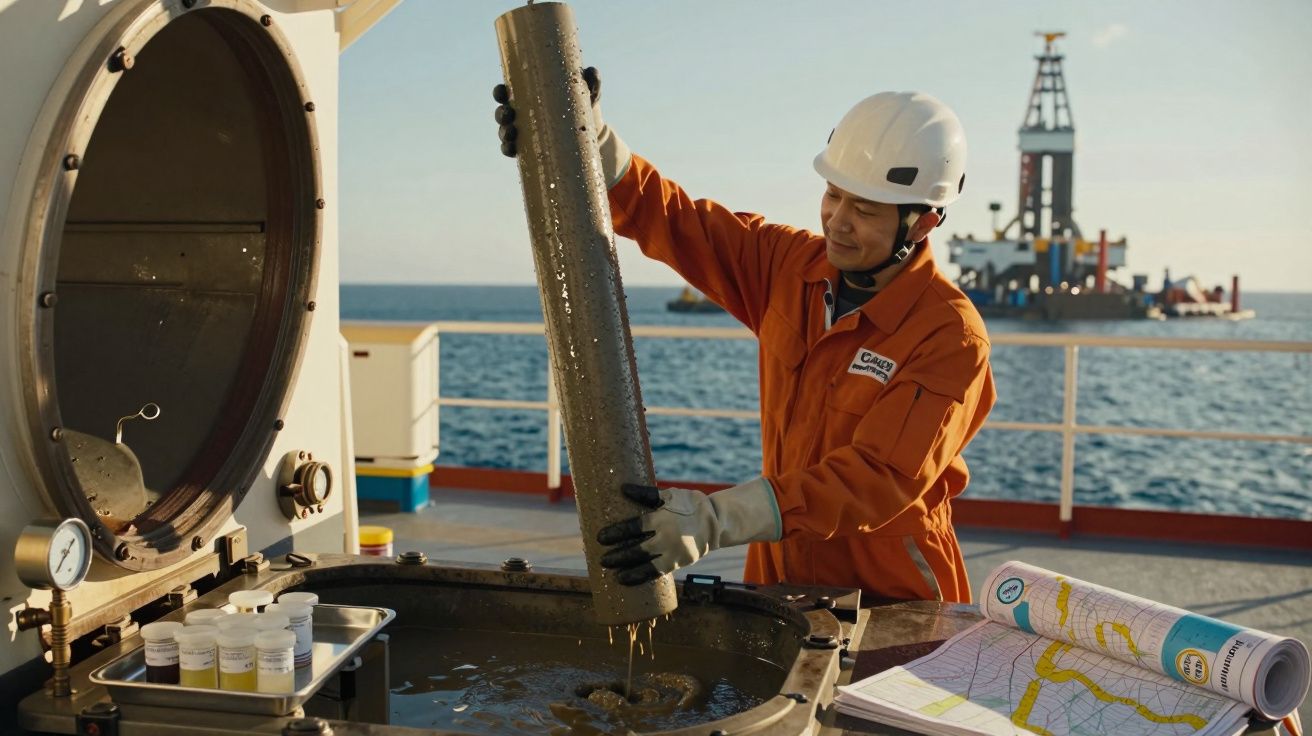
For a month, a towering drillship hovers above the Pacific abyss, trying to vacuum metal-rich mud from nearly four miles (six kilometers) down and send it straight to its deck in a continuous stream.
The Deep-Sea Gamble That Could Shake Up Rare Earth Supply
Japan has sent its flagship scientific drillship, the Chikyu, from the port of Shizuoka to the remote waters around Minamitori, a tiny coral atoll more than 1,100 miles (1,800 kilometers) from Tokyo. The mission: prove that rare-earth-rich mud can be pumped continuously from 19,685 feet (6,000 meters) below the surface up to a ship.
For Tokyo, this is not just about science. It is about strategic autonomy in some of the most sensitive materials on the planet: rare earth elements that sit at the heart of electric cars, smartphones, missiles, and wind turbines.
Japan is testing whether it can turn a geological curiosity on its own seabed into a controllable, domestically sourced supply of strategic metals.
Rare earths are a group of 17 metals. They are not truly scarce in the Earth’s crust, but high-grade deposits are uncommon, and extraction is messy and expensive. These elements power the magnets in EV motors, stabilize the beams in hospital MRI scanners, and brighten the pixels in your TV.
What Exactly Is at Stake: 17 Elements, One Technological Backbone
In policy debates, “rare earths” can sound abstract. They are not. Each element ends up in specific components that modern economies rely on every minute.
| Element | Type | Symbol | Typical uses |
|---|---|---|---|
| Lanthanum | Light | La | NiMH batteries, petroleum refining catalysts, optics |
| Cerium | Light | Ce | Catalysts for cars, glass polishing, electronics |
| Neodymium | Light | Nd | High-power magnets, EV motors, wind turbines |
| Terbium | Medium | Tb | High-performance magnets, sensors, lighting |
| Dysprosium | Heavy | Dy | Heat-resistant magnets, electric powertrains |
| Yttrium | Associated heavy | Y | Displays, lasers, specialized alloys |
Japan is especially interested in terbium and dysprosium-heavy rare earths that help magnets stay strong at high temperatures. They are vital for compact motors in electric vehicles and aircraft, and they are harder to substitute than some lighter elements.
Why Japan Is Heading to the Abyss
China dominates the rare earth chain, from mining to separation to refined products. Around 2010, Beijing temporarily tightened exports after a maritime dispute with Japan. Prices surged, and the message in Tokyo was blunt: do not rely on a single supplier for strategic inputs.
Since then, Japan has diversified. Chinese material once accounted for roughly 90% of its rare earth imports. That share has dropped closer to 60%, as new supply arrived from Australia, recycling programs, and strategic stockpiles.
Diversification helped, but it did not eliminate the underlying vulnerability: China still holds the commanding heights in processing capacity.
Beijing has recently tightened export controls on some technology-related materials, including key magnet metals. That has revived anxiety in Tokyo and Washington about “chokepoints” that could slow clean-energy transitions or defense procurement.
For Japanese policymakers, one route stands out: produce more at home-or at least under the Japanese flag. That is where Minamitori comes in.
Minamitori: A Lonely Coral Ring With Metal in the Mud
Minamitori, also known as Minami-Torishima, barely appears on most maps. It is a small, low-lying atoll, with no tourist-packed beaches and almost no permanent civilian life. What matters is what lies within Japan’s exclusive economic zone around it.
Japanese surveys over the past decade have mapped vast fields of mud on the abyssal plain near the atoll. These sediments, built up grain by grain over millions of years, contain unusually high concentrations of rare earths and other metals.
Unlike hard rock ore, this is soft material-closer to sticky clay than granite. Engineers think that could make it a better candidate for suction than for blasting or traditional drilling, at least in theory.
The challenge is in the numbers: 19,685 feet (6,000 meters) of water depth, immense pressure, delicate equipment, and powerful currents. Running a continuous pipe from the surface to the seafloor and pumping heavy slurry through it without clogging-or snapping the line-is far from simple.
Chikyu: Turning a Drillship Into a Giant Underwater Vacuum
The Chikyu is not a mining ship. It is a scientific drillship operated by JAMSTEC, Japan’s marine science agency. It was designed to drill deep into the Earth’s crust while staying almost perfectly still above a single point on the seafloor, using dynamic-positioning thrusters guided by GPS and subsea beacons.
For this mission, the ship will deploy a long riser-a vertical pipe system stretching down to the mud. Pumps will try to suck up the sediment and send it in a constant flow to the ship, where it will pass through separators and analytical equipment.
The real test is not whether mud can be raised once, but whether a stable, controllable industrial flow is possible at nearly four miles (six kilometers) depth.
If the pipes withstand pressure and flexing, if the pumps can handle dense sediment without jamming, and if the rare earth grades look commercially promising, Japan will move to a larger-scale trial.
Investment, Timelines, and Who Supplies Japan Today
Since 2018, Tokyo has invested roughly 40 billion yen (about $260 million) in the deep-mud rare earth program. Officials have avoided bold production claims. Instead, they emphasize phased validation, pilot projects, and economic assessment.
A larger demonstration campaign is tentatively planned for 2027, still framed as a test rather than a full mining operation. Production-if it happens-is usually discussed as a possibility in the early 2030s.
For now, Japan’s rare earth supply still looks like this:
| Source | Approximate share | Key aspects |
|---|---|---|
| China | 60–70% | Dominant supplier, especially for heavy rare earths; exposed to export controls |
| Australia | 15–20% | Mining and processing backed by Japanese financing; part of a diversification push |
| Domestic recycling | 5–10% | Recovery from magnets and electronics; steadily growing volumes |
| Strategic stockpiles | Not disclosed | Held for supply shocks; used sparingly |
| Subsea deposits (Minamitori, etc.) | 0% (future) | Estimated resources in the tens of millions of tons of mud; technology in testing |
| Other countries (U.S., Vietnam, etc.) | 5–10% | Secondary suppliers providing some political balance |
The Geopolitical Currents Under a Technical Experiment
Japan is not alone in looking to the seafloor. International debates around deep-sea mining have sharpened over the past five years, with Pacific island states, European governments, and NGOs arguing over how far and how fast extraction should go.
Tokyo’s project sits in a slightly different category. The target area lies within Japan’s exclusive economic zone, not in the international seabed area managed by the International Seabed Authority. That gives Japan far more control over timelines and standards, but it does not eliminate environmental scrutiny.
Any move from research to extraction will have to address concerns over sediment plumes, disturbance of deep-sea habitats, and the climate cost of opening a new industrial frontier.
For governments worried about China’s grip on supply, however, the appeal is clear. If Japan can make subsea mud technically and commercially viable, it would add a new, politically stable source of heavy rare earths. That would ripple through supply chains for electric cars, offshore wind, drones, and advanced sensors.
Risks, Unknowns, and the Environmental Question
Deep-sea mud pumping raises several major questions:
- Technical reliability: Can pumps and risers operate for months without catastrophic failure at extreme depth?
- Economic viability: Are the rare earth concentrations high enough to justify the energy and capital costs?
- Processing bottlenecks: Even with new ore, refined output still requires chemical separation plants-an area where China also leads.
- Environmental impacts: How far will plumes of disturbed sediment spread, and what will they do to deep ecosystems we barely understand?
Japan is running parallel work on life-cycle assessments, environmental baseline studies, and new recycling methods. Some researchers argue that deep mud could reduce certain impacts compared with land-based mines, such as deforestation or radioactive tailings. Others fear that damage to slow-growing deep-sea life would be hard to reverse-or even detect in real time.
How This Could Reshape the Rare Earth Puzzle
Even if the Chikyu mission succeeds, seafloor mud will not replace China’s role overnight. Refining capacity, skilled chemists, and long-term offtake contracts still anchor Beijing’s position. But additional supply from a G7 country would shift bargaining power.
For automakers, turbine manufacturers, and defense firms in Europe and North America, a successful Japanese subsea project would offer more options. It could also strengthen arguments for public funding of midstream processing capacity outside China, because feedstock risk would look slightly lower.
The deep-sea push also intersects with another quiet trend: better recycling. Japan has long used its dense industrial networks to recover metals from scrapped hard drives, motors, and old consumer electronics. Higher and more volatile prices make those efforts more attractive, which in turn could extend the impact of any future subsea production.
One useful way to view the Chikyu mission is as a stress test-not just of pumps and pipes, but of policy trade-offs. How much environmental risk will societies accept to stabilize green-technology supply chains? How should new ocean industries share benefits with future generations and neighboring states? The answers will shape not only Japan’s next move at Minamitori, but also debates over cobalt nodules, polymetallic sulfides, and other seabed riches waiting in the dark.






Comments
No comments yet. Be the first to comment!
Leave a Comment