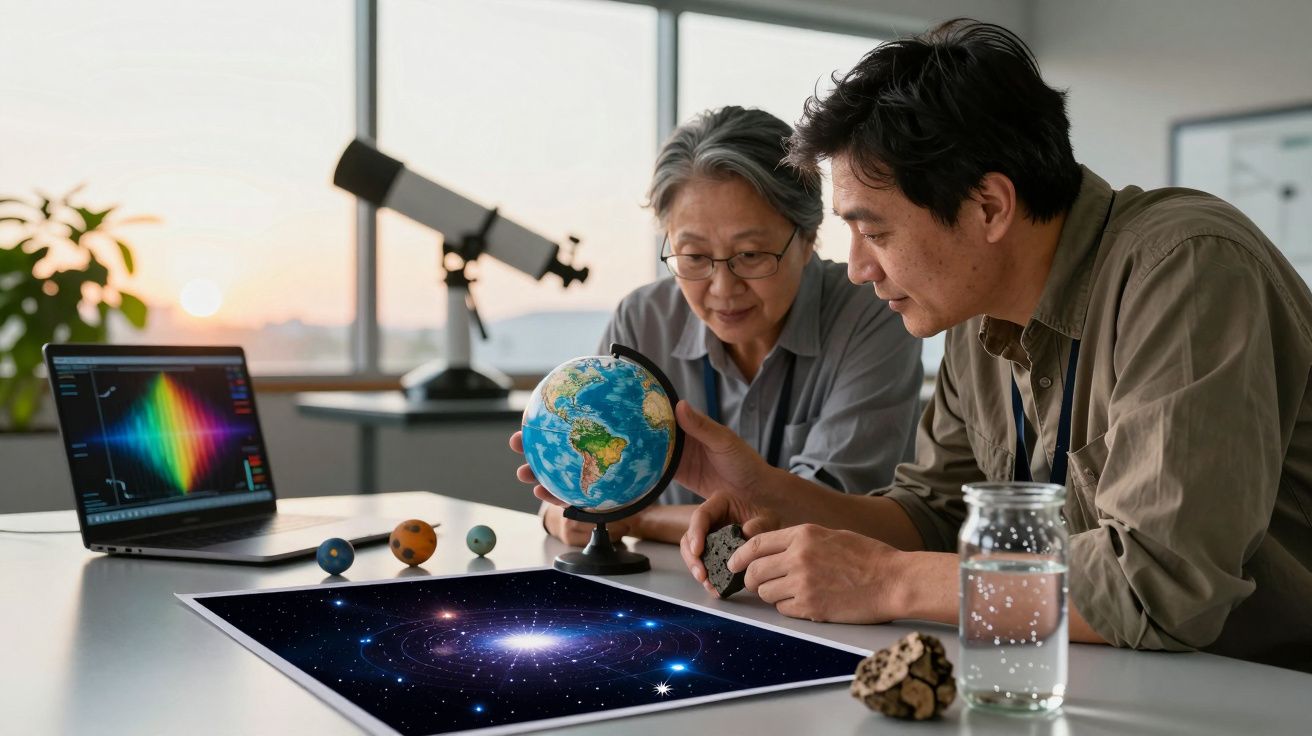
Scientists can now map distant planetary systems and drill into our own world’s past, yet the debate remains wide open: Is Earth a one-off accident, or simply one case among countless others?
Two Visions, One Question: How Special Is Our Planet?
The modern argument splits into two broad camps. One insists that every planet follows an unrepeatable chain of accidents. The other points to statistics: with so many stars and so many rocky worlds, Earth cannot be alone.
Earth looks ordinary when judged by size and orbit, but radically unique once you trace the full story that shaped it.
Both claims rest on hard data. Decades of robotic missions have transformed our view of the Solar System. At the same time, the exoplanet revolution has revealed that planetary systems crowd around almost every star we can survey.
From Dogma to Data: How the Question Changed
For centuries, arguments about Earth’s uniqueness came from philosophy or theology, not measurement. Some traditions placed humanity and its home world at the center of creation. Others, from Epicurus to Giordano Bruno, argued that countless other worlds must exist around distant suns.
The turning point arrived when physics showed that the same laws seem to operate everywhere. Gravity, thermodynamics, and atomic physics describe both falling apples and colliding galaxies. If the rules are shared, the reasoning went, the “recipe” that produced Earth should apply elsewhere.
That view dominated the early space age. Many researchers expected that surveying the Solar System would reveal planets broadly similar to ours, perhaps with modest variations. Spacecraft sent to Venus, Mars, the gas giants, and their moons shattered that hope.
A Solar System Far Stranger Than Expected
Close-up data from missions such as Mariner, Voyager, Galileo, Cassini, and many others forced a rethink. Instead of a tidy family of near-Earths, scientists found sharp contrasts:
- Venus: Roughly Earth-sized, but wrapped in a crushing atmosphere with an oven-hot surface.
- Mars: Cold, thin air, a fossilized landscape bearing traces of ancient water flows.
- Gas giants: Deep, stormy atmospheres, ring systems, and complex magnetic environments.
- Icy moons: Hidden oceans, geysers, and chemistry that might support microbial activity.
The planets follow the same physical laws, but outcomes diverge wildly. Tiny shifts in composition, distance from the Sun, impact history, or internal heating lead to very different worlds.
The new paradigm is not uniformity, but planetary diversity built from the same simple rules applied in different settings.
The Role of Cosmic Accidents: Collisions, Migrations, and Forks in the Road
Modern planetary science explains that diversity through a mix of general processes and local circumstances. Protoplanetary disks of gas and dust give rise to:
- planetary migration, as young worlds exchange momentum with the surrounding disk,
- gravitational instabilities that reshuffle orbits,
- giant collisions between growing protoplanets.
These mechanisms occur almost everywhere, but not in the same way. Timing, angles, masses, and initial conditions vary from system to system. One famous example is the impact thought to have formed the Moon.
Models suggest a Mars-sized body struck the early Earth. The violence of that encounter likely influenced our planet’s rotation, tilt, tectonic regime, and even the long-term stability of its climate. A slightly different impact speed or geometry could have produced a world with a very different atmosphere, ocean inventory, or internal structure.
In that sense, each planet follows a branching path filled with forks. Two systems can start from similar disks and still end up with contrasting configurations. The laws remain deterministic, yet the sequence of events introduces a strong element of contingency.
What Do We Mean by “Another Earth”?
This leads to a crucial semantic point. When scientists ask whether Earth is unique, they rarely mean only “a rocky planet, roughly Earth-sized, in the temperate zone.” If that were the sole criterion, many “exo-Earths” likely exist.
The harder question is whether any other world shares a deep set of properties shaped by billions of years of local history: plate tectonics of a specific style, a long-lived magnetic field, surface oceans persisting for eons, a stable axial tilt, a particular mix of atmospheric gases and minerals, and a biosphere that transformed its environment.
The more features you add to the checklist, the less likely you are to find a perfect twin, even in a galaxy rich in rocky planets.
From this viewpoint, every planet becomes a one-off product of its own improbable timeline. Earth may not be rare as a category, but it becomes unique as an individual.
The Exoplanet Revolution: Earth as One Rocky World Among Many
The second vision leans on a different kind of evidence: statistics from exoplanet surveys. In 1995, the first confirmed planet around a Sun-like star was announced. Since then, instruments on the ground and in space have cataloged thousands of worlds around other stars.
Observations using Doppler spectroscopy track the subtle wobble of stars under the pull of their planets. Transit methods monitor dips in brightness when a planet crosses in front of its host star. Combined, these techniques reveal sizes, orbits, and in some cases, estimates of mass and density.
Planetary Systems Seem Almost Universal
Data from missions such as Kepler and TESS suggest that planets form as a natural by-product of star formation. The rotation and angular momentum of collapsing gas clouds tends to produce a disk, and those disks fragment into planetary bodies.
| Property | Solar System | Typical exoplanet findings |
|---|---|---|
| Presence of planets | 8 main planets | Planets around most stars surveyed |
| Dominant types | 4 rocky, 4 giants | Many sub-Neptunes, mini-Neptunes, hot Jupiters |
| Orbital shapes | Mostly near-circular | Wide range, including highly eccentric orbits |
| Close-in giants | None | Common in early discoveries, due to detection bias |
One robust trend stands out: small rocky planets, with masses similar to Earth, appear common. Surveys indicate they outnumber giant worlds like Jupiter. Theoretical models agree, since building a small rocky core from dust is easier than gathering huge envelopes of gas.
Migration Reshapes Planetary Systems
Early expectations assumed giant planets would form far from their stars, where ices can survive. The first “hot Jupiters” overturned this picture. These objects, similar in mass to Jupiter but orbiting in just a few days, showed that large-scale movement must occur.
As a young planet interacts with the surrounding disk, it can lose or gain angular momentum and spiral inward or outward. This migration helps explain the wide variety of orbital architectures now observed.
Instead of a single blueprint, planetary systems behave like experiments run under slightly different initial conditions, each rearranged by migration and chaos.
Life, Water, and the Question of Habitability
The most emotionally charged part of the debate concerns life. Most researchers agree that, as we know it, life needs liquid water, a source of energy, and a supply of complex chemistry. That focuses attention on “temperate” rocky planets, where surface temperatures might allow oceans.
Estimates remain rough, but even a conservative scenario leads to staggering numbers. If only a few percent of planetary systems host at least one temperate rocky planet, then our galaxy alone could hold billions of such worlds.
To grasp the scale, compare that with Earth’s own diversity. Our planet hosts boiling hydrothermal vents, subglacial lakes, deserts bathed in ultraviolet light, acidic hot springs, and deep crustal rocks warmed only by the planet’s interior. Microbes cope with each niche in surprisingly inventive ways.
Now spread comparable variety across hundreds of millions or billions of rocky planets. Claiming that chemistry never once crossed the threshold into biology anywhere else becomes a bold statement, not a cautious one.
Why Finding Life Is Still Hard
Yet, for all the suggestive numbers, proof remains missing. Detecting life beyond Earth is technically demanding. Candidates include:
- hidden oceans on icy moons, such as Europa or Enceladus, where plumes leak material into space,
- subsurface habitats on Mars, protected from radiation and temperature swings,
- atmospheric signatures on distant rocky exoplanets, hinting at biological activity.
Upcoming telescopes aim to dissect the light from exoplanet atmospheres. Researchers will look for combinations of gases that are hard to maintain without biology, such as oxygen mixed with certain reducing compounds. These signals can be subtle and ambiguous, meaning debates about false positives and non-biological processes will continue.
Right now, the only rigorous answer science can give to “Is there life elsewhere?” remains: keep searching, with better tools and clearer hypotheses.
Two Truths That Can Coexist
The tension between the “Earth is unique” and “Earth is common” positions softens if you separate categories from individuals.
- As a type-a temperate, rocky planet around a normal star-Earth likely belongs to a crowded class.
- As a history-a precise series of impacts, climate shifts, biochemical innovations, and feedbacks-Earth looks unrepeatable.
This dual view mirrors what happens in biology. Species share features because they follow genetic rules and evolutionary constraints. Yet every organism carries a unique life story. Planets may follow an analogous pattern: shared physics, individual trajectories.
What Comes Next: Simulations, Risks, and Side Stories
Future work will not only catalog more exoplanets. Teams run massive simulations that track millions of virtual planetary systems over billions of years. By tweaking initial disk masses, chemical compositions, and stellar activity, they test how sensitive habitability is to early chaos.
These virtual experiments feed directly into mission design. If simulations show, for example, that long-lived surface oceans rarely survive around very active red dwarf stars, agencies might prioritize Sun-like targets. If they suggest that moons of giant planets offer stable environments, instrument builders may tune spectrographs to pick up subtle signatures from exomoons.
There is also a more sobering aspect. Seeing Earth as one member of a vast population of rocky worlds reframes our own risks. Climate disruption, biosphere loss, or large impacts do not just threaten human society; they threaten a very specific and perhaps fragile chemical story that took billions of years to unfold. From that angle, planetary protection stops being abstract and becomes a concrete defense of a singular outcome of cosmic history.
Finally, some researchers widen the lens beyond biology and ask about technology. If many planets host life, a fraction might give rise to tool-using species, and an even smaller fraction might build radio transmitters or space probes. That chain of reasoning leads to classic questions about the apparent silence of the sky, often examined through the Drake equation and studies of so-called technosignatures. These efforts add another dimension to the original question: not only, “Is Earth unique as a planet?” but also, “Is our civilization rare as a phase in planetary evolution?”






Comments
No comments yet. Be the first to comment!
Leave a Comment