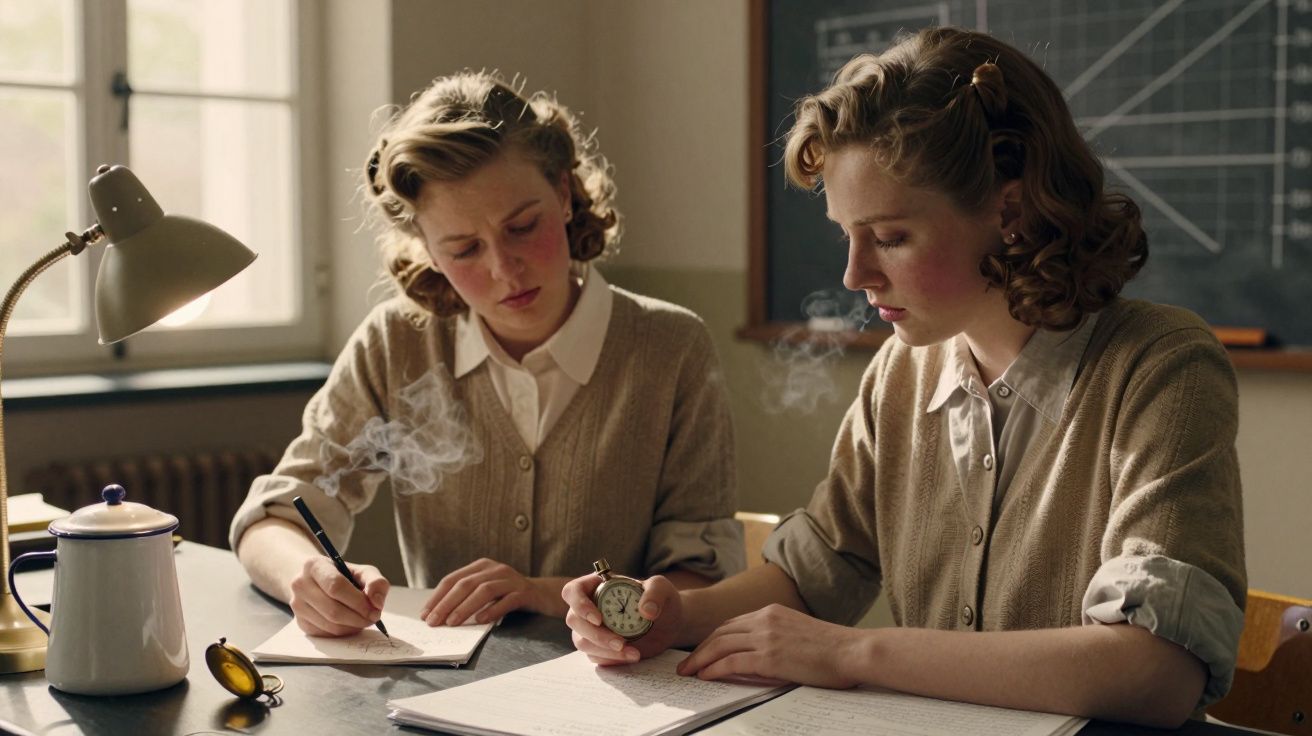
A sweltering summer in Washington, a bold psychology professor, and seven sleepless students chasing a dangerous dream of efficiency.
In 1925, at a time when the United States glorified productivity and speed, a small campus experiment in Washington tried to answer a question that now seems almost absurd: Could humans simply train themselves not to need sleep?
When Staying Awake Became a Scientific Stunt
The setting was George Washington University, in the Foggy Bottom neighborhood. Psychology professor Frederick August Moss believed sleep was more a cultural habit than a biological need. To him, eight hours a night meant wasting a third of life doing nothing. The industrial boom of the 1920s seemed to back him up. Factories ran around the clock, and inventors like Thomas Edison boasted of sleeping only a few hours.
Moss decided to turn this belief into data. He recruited seven students for what was presented as a serious laboratory study, but it also had the feel of a dare. Their task sounded simple on paper: stay awake for 60 straight hours, from Friday evening to Monday morning, while being measured, tested, and watched.
The experiment’s goal was not to understand why we sleep, but to prove that we might not need to.
The weekend quickly became a carefully orchestrated battle against fatigue. To keep the group alert, Moss and his assistants rotated activities:
- Animated late-night conversations in the lab
- Car rides through rural Virginia to stimulate their senses
- Impromptu baseball games to boost circulation and focus
- Simple coordination tasks, repeated again and again
Every few hours, the students completed cognitive tests, reaction-time drills, and memory exercises. Moss timed their responses, noted their mistakes, and watched for signs of collapse. The students joked, yawned, argued, and insisted they felt “fine,” even as their performance steadily declined.
The Women Who Turned a Stunt Into a Career
Two of the volunteers, Thelma Hunt and Louise Omwake, would later become central figures in American psychology. At the time, they were 22-year-old students taking a risk in a male-dominated field. Their participation in Moss’s bold study was not just an odd weekend story-it was part of a broader push to be taken seriously as researchers.
Hunt went on to shape educational psychology and mental testing, while Omwake later led the psychology department at George Washington University. Archival records from Smithsonian historians show how both women navigated a discipline that often sidelined them, using every research opportunity-even a 60-hour sleepless marathon-to build credibility.
Behind the headline-friendly stunt was a quieter story: women carving out scientific authority in a field that barely wanted them.
What 60 Hours Awake Actually Did to Their Minds
At first, Moss felt confident. During the opening hours, the students laughed off yawns and performed well on tasks. They parked cars with precision, solved logic puzzles, remembered word lists, and hit baseballs cleanly. He interpreted their resilience as proof that humans could adapt to far less sleep than custom dictated.
As the hours passed, a different picture emerged. Reaction times slowed. Fine motor skills faltered. Students misjudged distances when parking. They fumbled simple arithmetic. Some grew irritable, others giddy. Memory tests showed more lapses. Yet no one collapsed or suffered dramatic physical failure, which Moss took as support for his theory that the brain might simply “push through” fatigue.
Not everyone in science shared his optimism. That same summer, a laboratory at the University of Chicago reported that attempts to cut sleep consistently harmed health and function. Their work aligned with an early consensus: depriving the brain of rest disrupted core processes, even if people insisted they felt “okay.” Subjective confidence did not match objective performance.
The Moss trial helped establish a pattern that still shapes sleep research today: people think they’re coping long after the data shows their brain is not.
From Mysterious Nights to Mapped-Out Sleep Cycles
The real transformation came decades later. In the mid-20th century, researchers like Nathaniel Kleitman and Eugene Aserinsky in Chicago shifted from timing tasks to observing the brain directly. Using electroencephalography (EEG), they tracked electrical activity while volunteers slept and discovered something startling: sleep followed a structured series of stages, not a uniform blur of unconsciousness.
They observed periods of rapid eye movement-now known as REM sleep-when the brain lit up almost as much as during wakefulness. Heart rate varied, breathing changed, and vivid dreams unfolded. Early work suggested that during these phases, the brain reorganized memories, reinforced learning, and maintained emotional balance.
Other stages, deep non-REM sleep in particular, appeared linked to tissue repair, immune responses, and metabolic regulation. The old view of sleep as dead time began to crack. Instead of idleness, the night looked more like a complex maintenance shift.
| Sleep stage | Main role | What goes wrong when cut |
|---|---|---|
| Light non-REM | Transition to deeper sleep, sensory disconnection | Fragmented nights, daytime grogginess |
| Deep non-REM | Physical repair, immune support | Weaker immunity, higher pain sensitivity |
| REM sleep | Memory consolidation, emotional processing | Poor recall, mood instability, irritability |
With these findings, Moss’s claim that sleep might be optional started to look like wishful thinking born of the industrial age.
From Heroic Sleeplessness to Chronic Sleep Debt
A century later, the Moss experiment feels strangely familiar. Modern work culture still rewards those who answer emails at midnight, brag about 5 a.m. workouts, and treat weekends as an extension of office hours. The language has changed, but the suspicion that sleep wastes time lingers.
Contemporary research paints a very different picture. Large epidemiological studies have linked short sleep-usually under six hours a night-with higher risks of:
- Type 2 diabetes and weight gain
- Hypertension and cardiovascular disease
- Depressive symptoms and anxiety
- Reduced immune response to infections and vaccines
- Increased accident rates at work and on the road
These effects often build slowly. People accumulate what specialists call “sleep debt”: nightly deficits that add up over weeks, dulling attention and memory long before they feel truly exhausted. Like Moss’s students trying to park a car at hour 55, many modern workers operate with subtle cognitive impairments they barely notice.
Productivity culture still treats sleep as a negotiable luxury, while data links its absence to errors, illness, and shorter life expectancy.
When Too Much Sleep Also Raises Questions
Recent data complicates the story further. Several massive population studies show a U-shaped curve between sleep duration and health risk. People who regularly report very short nights and those who report unusually long nights both show higher rates of illness and earlier death.
This pattern does not mean that long sleep directly causes disease. Researchers suspect it often signals that something else is going on-sleep apnea, chronic inflammation, metabolic disorders, or untreated depression, for example. Rather than targeting “long sleepers,” specialists now urge doctors to ask why a person needs so much rest just to feel barely functional.
What Scientists Now Recommend for Everyday Sleep
Current guidance focuses less on heroics and more on consistency. Most healthy adults function best with roughly seven to nine hours of sleep, but timing and regularity matter just as much as total minutes. Your body runs on circadian rhythms driven by light, hormones, and habit.
Sleep doctors often point to a few simple levers that work for many people:
- Going to bed and waking up at roughly the same time every day, weekends included
- Keeping bedrooms cool, quiet, and dark to support natural melatonin release
- Avoiding caffeine late in the day and large meals just before bedtime
- Limiting bright screens in the hour before sleep, since blue light delays the body clock
- Using the bed mainly for sleep and intimacy, not work or scrolling
Compared to Moss’s marathon vigil, this advice looks ordinary. Yet it reflects decades of carefully collected data rather than a single dramatic weekend.
Why the 1925 Experiment Still Matters Now
The George Washington University trial sits at an awkward intersection of science and spectacle. It rested on a flawed premise, underestimated hidden harm, and aimed to prove a conclusion rather than test a question. Yet it also captured a cultural obsession that has barely faded: the dream of squeezing more waking hours out of each day.
Looking back, the experiment sheds light on several ongoing debates. Modern shift-work schedules, overnight gig-economy jobs, and always-on communication keep pushing the limits Moss wanted to break. Instead of weekend stunts, many people now live in near-permanent mini-experiments with their own sleep patterns-without monitoring and without consent.
The story also highlights how beliefs about sleep shape behavior. When a society admires those who claim to live on four hours a night, individuals feel pressure to match that standard, despite genetic differences in sleep needs. Genuine “short sleepers” do exist, but they are rare. Most people trying to imitate them pay with slower thinking, higher stress, and more health problems.
One last twist: sleep researchers now use controlled deprivation very differently than Moss did. Modern labs sometimes keep volunteers awake to study how the brain processes emotions, how memory breaks down, or how psychiatric symptoms change after a missed night. These protocols run under strict ethical rules, with medical monitoring and clear cutoff points. The goal has flipped-from proving sleep is optional to showing just how deeply it shapes every waking moment.






Comments
No comments yet. Be the first to comment!
Leave a Comment