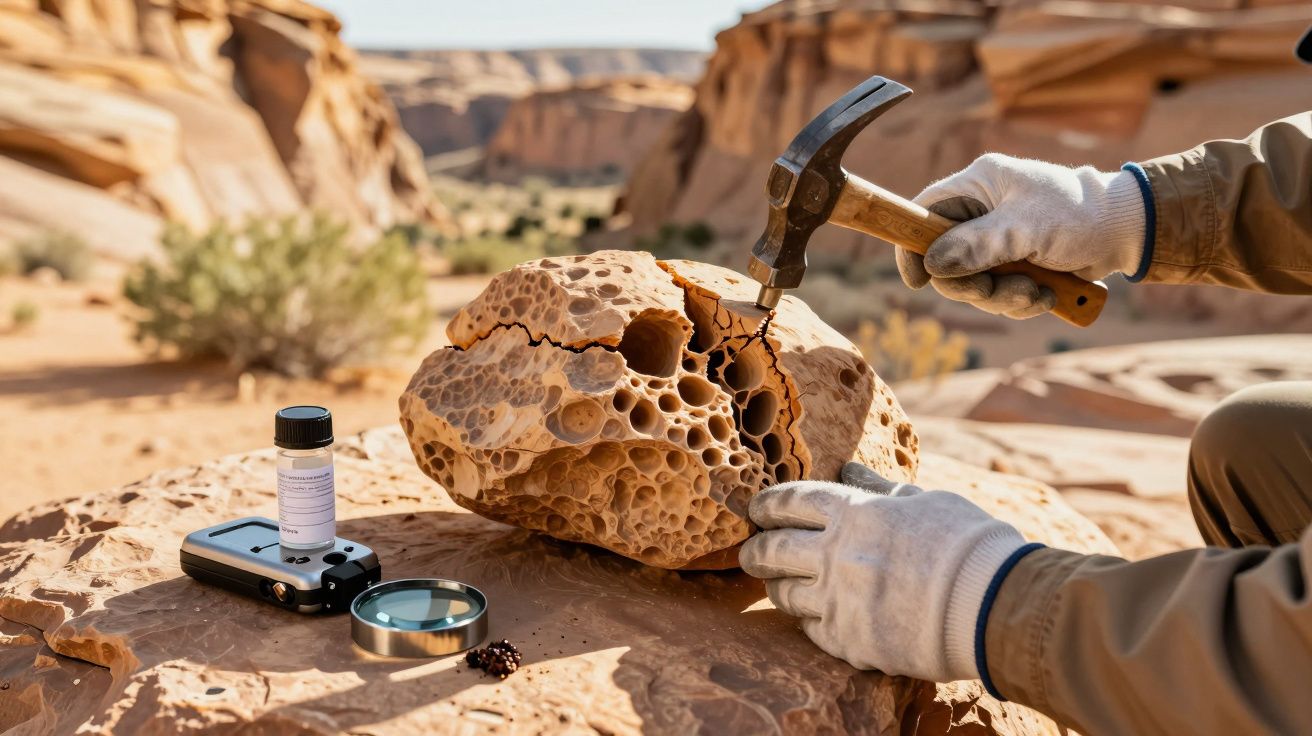
Those neat lines etched deep into marble and limestone might not be scars from wind or heat, but marks left by a vanished life-form that literally ate its way through stone. A new study suggests these microscopic tunnels could belong to an organism never observed alive-yet one that may have quietly influenced Earth’s carbon balance for millions of years.
Strange Tunnels in Desert Rocks
The story begins in Namibia more than fifteen years ago. While surveying marble outcrops, geologist Cees Passchier of Johannes Gutenberg University Mainz noticed something that didn’t match anything in the textbooks. Beneath the polished stone surface, cut sections revealed bundles of needle-like tubes running side by side through the rock.
Each tunnel is only about 0.5 millimeters wide but can reach up to three centimeters deep. They appear in straight, parallel bands, always perpendicular to the rock surface and often emerging from natural fractures. The pattern looks deliberate-almost engineered-yet nothing mechanical ever touched these ancient desert cliffs.
Similar structures later appeared in Oman and Saudi Arabia, sometimes in Cretaceous-age limestone. Different continents, different ages, same geometry. That consistency immediately troubled the team, because no common geological process seemed to fit.
Geological erosion produces chaotic pits and irregular channels. These tunnels look organized, aligned, and unusually disciplined.
Passchier and his colleagues considered the usual suspects. Wind-blown sand? Too random. Dissolution by flowing water? The holes were in bone-dry, exposed outcrops, far from any recent groundwater. Micro-fracturing from tectonic stress? That can break rock, but it doesn’t create orderly vertical tubes filled with different material.
After ruling out standard non-biological explanations, the researchers turned to a more unsettling possibility: something once lived in these rocks and left structures behind.
Clues Pointing to Fossilized Biological Activity
Thin sections examined under a microscope show the tunnels aren’t empty. Each is filled with a fine, pale calcium carbonate deposit that differs from the surrounding marble or limestone. Chemically, the fill contains far less iron, manganese, strontium, and rare earth elements than the host rock.
This selective depletion suggests some process sorted the elements-concentrating some while removing others. Random chemical weathering typically wouldn’t produce such a clean separation across thousands of individual tunnels.
The chemical fingerprints inside the tunnels look like the leftovers of a living process, not just chemistry acting blindly on stone.
Isotopic measurements reinforce that suspicion. The carbon and oxygen isotope ratios inside the tunnel fill differ from those in the original carbonate. That kind of shift often points to biological activity, where microbes process carbon and oxygen in distinctive ways.
Raman spectroscopy-which detects molecular vibrational signatures-found traces of fossil organic carbon in some deposits. That carbon likely comes from degraded cells or biofilms that once lined the tunnel walls.
There’s more: the inner tunnel surfaces are enriched in phosphorus and sulfur. These elements are central to DNA, cell membranes, and many proteins. Their concentration along the walls (instead of evenly throughout the rock) fits with the idea that cells once adhered there.
Yet the overall tunnel architecture doesn’t match any known fungus, lichen, cyanobacteria, or root structure. There are no branches, no wandering filaments, and no widening and narrowing like plant roots. The tunnels are straight, individual shafts marching in formation through mineral.
A Rock-Boring Microbe That May Have Fed on Hydrocarbons
The team now leans toward a bold hypothesis: the tunnels formed when an unknown endolithic microorganism colonized fractures in carbonate rocks and drilled inward in search of food.
Endolithic organisms live inside rock, in tiny pores or cracks. Modern examples include bacteria and algae that survive in translucent Antarctic stones by using light that penetrates just a few millimeters below the surface. But these desert tunnels aren’t near the surface, and the rocks are often opaque-ruling out life dependent on sunlight.
Instead, the hypothetical microbe may have relied on chemical energy stored in organic molecules trapped in the rock-for example, remnants of ancient marine life preserved as hydrocarbons in limestone. To reach those compounds, the cells may have secreted organic acids that slowly dissolved calcium carbonate, pushing forward as they consumed their way inward.
As the leading edge advanced, dissolved minerals could have re-precipitated behind it, leaving the pale carbonate infill visible today. Over time, the colony died and decayed, but the mineral casts of its tunnels remained as ghostly evidence.
- Host rocks: marble and limestone in Namibia, Oman, and Saudi Arabia
- Tunnel size: ~0.5 mm wide, up to 3 cm deep
- Estimated age: roughly 1–3 million years
- Environment: arid deserts with extreme temperature swings
A Hint of “Chemical Intelligence” in Stone
One of the strangest features is the tunnel layout. They rarely cross or collide. They stay parallel, with fairly regular spacing-like lanes on a microscopic freeway. That pattern suggests coordination, even without a brain or nervous system.
The rocks appear to preserve a frozen snapshot of a colony managing its own expansion, guided by chemical signals rather than conscious thought.
Modern bacteria often follow chemical gradients toward nutrients or away from toxins, a behavior known as chemotaxis. The Mainz team suspects something related here, but operating across a community rather than a single cell.
Imagine millions of cells along a fracture surface sensing organic-rich patches deeper in the rock. As some begin tunneling, they release byproducts that subtly change local chemistry. Neighboring cells detect those changes and adjust direction or spacing, avoiding already exploited zones and minimizing overlap.
How the Tunnels May Have Formed, Step by Step
| Stage | Process in the rock |
|---|---|
| 1. Colonization | Microbes settle along a fracture or surface in carbonate rock, drawn by traces of organic matter. |
| 2. Dissolution front | Cells secrete organic acids that locally dissolve CaCO₃, opening a narrow path into the rock. |
| 3. Tunnel growth | The colony advances as a band of cells, leaving a clean, straight micro-burrow behind. |
| 4. Mineral backfill | Dissolved carbonate recrystallizes behind the active front, filling the tunnel with chemically distinct CaCO₃. |
| 5. Fossilization | After the colony dies, organic matter decays, but the mineral cast of the tunnel persists for millions of years. |
Some tunnel fills show concentric layering, almost like tree rings. That pattern suggests growth wasn’t constant. Seasonal humidity, rare rain events, or shifts in nutrient availability may have caused bursts of activity followed by quiet periods-recorded as chemical bands in stone.
Could Stone-Eating Microbes Affect Earth’s Carbon Cycle?
Carbonate rocks like limestone and marble store enormous amounts of carbon as CaCO₃. Over geologic time, this reservoir helps regulate how much carbon dioxide circulates between the atmosphere, oceans, and crust.
If a microbe dissolves carbonate as it feeds, it can release that stored carbon locally. Immediate products might include dissolved inorganic carbon or CO₂ in tiny fluid pockets. Much of this may later react again or re-precipitate, but over very long timescales the balance can shift.
Repeated across vast desert outcrops and over millions of years, microscopic rock-boring could subtly reshape carbon flows between stone and air.
Weathering already releases CO₂ as rainwater slowly dissolves limestone cliffs and cave systems. The proposed microbe would add a biological shortcut, accelerating dissolution in protected fractures and surfaces that water alone can’t easily reach.
Climate models often treat carbonate rocks as mostly passive, changing only through slow chemical and tectonic processes. If this kind of biological tunneling is widespread in the geologic record, modelers may need to revise assumptions about how quickly carbon can move out of the crust.
Timing matters too. If these organisms thrived during certain climate phases, they may have contributed to unexplained swings in ancient CO₂ levels-especially in arid regions where other life struggles to alter rocks at depth.
A Potential New Branch of the Tree of Life-Now Missing in Action
So far, no usable DNA or proteins have been found in the tunnel fills. Age estimates place the structures at 1–3 million years old, and the combination of heat, dryness, and oxidation in deserts destroys genetic material quickly.
That leaves researchers in a difficult position: strong circumstantial evidence for a biological origin, but no living culture to grow in a lab, no genome to sequence, and no direct observation of tunneling in progress. The organism may be extinct-or it may survive in hidden pockets that haven’t been sampled yet.
Passchier’s team is urging geologists and microbiologists worldwide to check desert outcrops, old quarries, and carbonate cliffs for the same kind of parallel micro-tunnels. If similar features appear across different climates or time periods, patterns may emerge showing where and when this mysterious lifestyle flourished.
Why Geologists Care About Life Inside Rocks
This research sits at the intersection of sedimentology, geomicrobiology, climate science, and even astrobiology. Endolithic life shows how organisms can survive in places that seem completely hostile-feeding on trace chemicals and reshaping minerals from within.
For planetary scientists, rock-boring microbes on Earth provide a template. If life ever arose on Mars or icy moons like Europa, it may have retreated into rock or ice rather than living on the surface. Subtle textures, chemical halos, or micro-tunnels in alien rocks might be the only evidence left behind.
The study of these Namibian and Arabian tunnels also connects to practical concerns. Microbes that dissolve carbonate could affect the stability of building stone or underground storage reservoirs. In carbon capture projects-where CO₂ is injected into carbonate formations-understanding potential biological feedback becomes more than a theoretical issue.
Researchers already simulate microbial growth in porous rock to predict how biofilms change permeability and strength. Adding this kind of directed tunneling to models could improve predictions for fracturing, fluid flow, and long-term carbon storage in engineered reservoirs.
For now, Earth’s deserts hold the only known examples, and they raise more questions than answers. What metabolism powered this organism? Did it use oxygen, or did it rely on sulfate or nitrate as electron acceptors? Did it act alone, or in partnership with other soft-bodied microbes that left no trace?
Future field campaigns may combine careful mapping of tunnel bands with micro-drilling, advanced imaging, and lab experiments aimed at recreating similar structures. Even if the original organism is never found alive, these desert tunnels already expand our understanding of where life can operate-and how quietly it can rewrite the chemistry of the stone beneath our feet.






Comments
No comments yet. Be the first to comment!
Leave a Comment