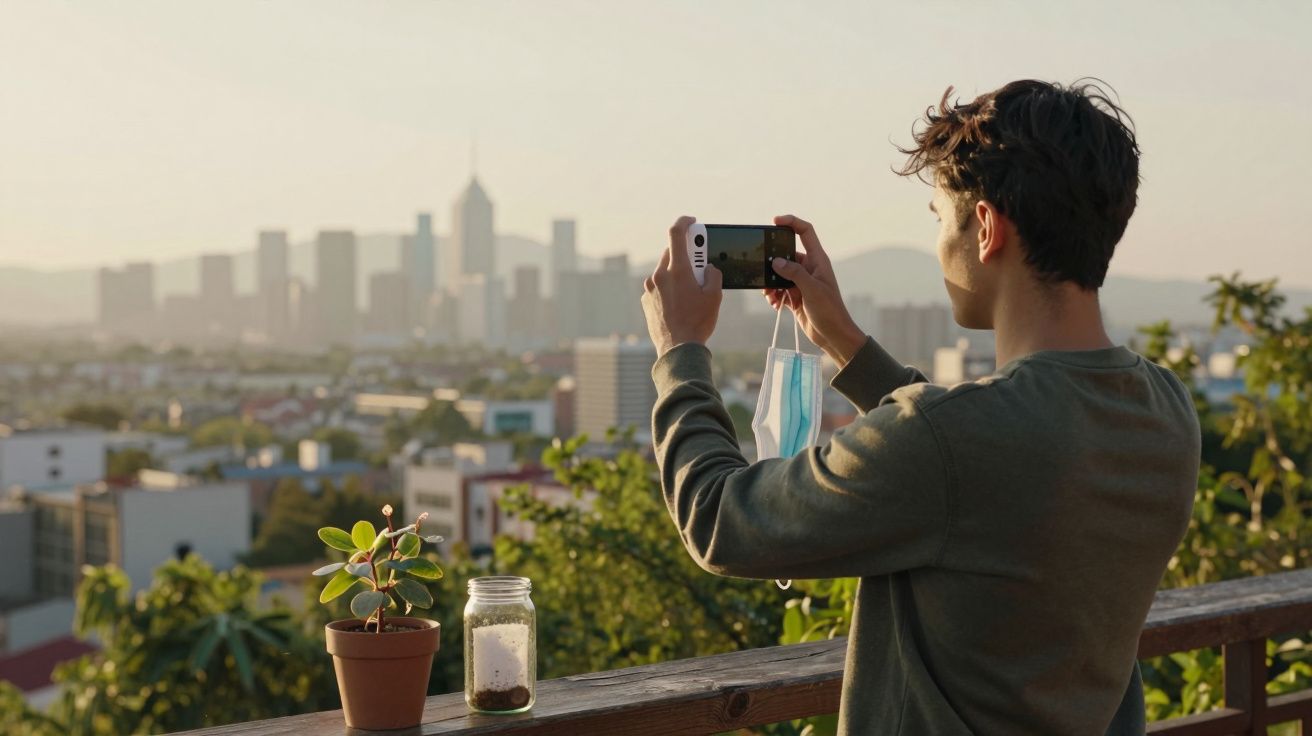
That mountain range you loved-the one that used to cut the sky in sharp blue and granite gray-now looks like a faded backdrop. The horizon seems washed out, like someone dragged a dirty brush across the lens.
Then you see it in real life. Planes vanish into a milky haze long before they should. City skylines blur, even on “clear” days. Sunsets go from crisp to smudged, as if the world has lost some of its focus.
For a long time, many of us blamed the weather, or “just a bit of mist.” But the air has changed-now invisibly crowded with tiny particles we rarely think about. They’re reshaping how far we can see. And what we’d rather not see.
When clear horizons quietly vanish
On a summer afternoon in the Rockies, a park ranger pointed across the valley and sighed. The famous peak that usually dominates the view was barely a silhouette, its edges swallowed by a pale gray curtain. Tourists still snapped selfies, but their screens showed a landscape that felt strangely tired.
That washed-out look isn’t only about smoke or fog. Invisible specks of dust, soot, sulfates, and organic compounds hang in the air, scattering and absorbing light in every direction. Instead of traveling cleanly from mountain to eye, sunlight gets bounced around like it’s in a cluttered room of mirrors. The result: skies lose depth, distances shrink, and horizons fade.
We often notice this more in places we love. A childhood coastline that once seemed endless now looks shorter. A familiar road melts into a low-contrast blur after a few hundred yards. Once you start noticing this loss of clarity, you can’t really unsee it. The world feels closer, but not in a good way.
Take Beijing in winter or Delhi in late fall. On paper, visibility might be reported at two or three miles. In real life, the skyline looks like stacked shadows, each layer swallowed by thicker smog the farther you look. Buildings that used to stand proudly against a blue canvas now dissolve into beige air by mid-morning.
Los Angeles, once infamous for its brown haze, is a different kind of story. Since stricter air-quality rules took hold, researchers have measured visibility improvements of dozens of miles on some days. Old photos from the ’70s show a city under a dirty dome. Today, there are more days when the mountains behind LA are visible again-a reminder that these trends aren’t fate, but choices.
Even rural regions aren’t spared. In the United States, National Park Service data show that human-caused haze has cut natural visibility in many parks by more than half compared with pre-industrial times. You might still get the postcard shot, but the fine details, the distant ridgelines, the crisp separation between earth and sky? They’re often missing, replaced by a kind of permanent visual fatigue.
The science behind this is deceptively simple. Atmospheric particles-what scientists call aerosols-are tiny bits of solid or liquid matter floating in the air. Some come from natural sources like sea spray or volcanic eruptions. Others come from car exhaust, coal plants, agricultural burning, and even home heating and cooking.
These particles interact with light in two main ways. Larger or darker ones, such as soot, tend to absorb it, dimming the scene like a veil. Smaller, lighter-colored particles scatter light, throwing it in all directions. When the air is packed with these specks, the straight path from object to eye gets muddled. Contrast drops. Edges soften. The horizon stops being a line and becomes a guess.
What makes this even more unsettling is that some “cleaner” technologies can still add to the haze. Scrubbers on power plants reduce certain gases but can increase the formation of sulfate aerosols. Even climate change plays a strange role: hotter, drier conditions fuel wildfires, which throw massive amounts of smoke into the sky. The air may carry fewer big chunks of dust than decades ago, yet still be more crowded with these tiny, troublemaking particles.
What you can actually do about a hazy world
On a personal level, you can’t clear the whole sky, but you can change the air in your daily life. One obvious but powerful move is to rethink how you get around. Swapping a few car trips a week for walking, biking, or public transportation reduces the local traffic plume that you and your neighbors literally breathe-and see.
At home, paying attention to what you burn matters more than you might think. That cozy wood fire? It releases fine particles that can linger far beyond the living room, especially on still winter nights. Using cleaner heating systems, maintaining boilers, and choosing induction over gas stoves when possible-these small technical choices reduce the mix of particles building up in your street and city.
Then there’s the less visible power of what you support. When residents push for low-emission zones, cleaner buses, or stricter controls on industrial smoke, they aren’t just chasing abstract “climate goals.” They’re fighting for the right to see the outline of the hills again. Clear horizons are political, not just poetic.
There’s also a more personal side: protecting yourself on days when the air turns thick. Simple habits like checking local air-quality indexes before a run, closing windows during rush-hour pollution spikes, or using a basic air purifier in a bedroom can soften the impact of high-pollution episodes. Not glamorous, but quietly effective.
Many people feel guilty for not following every “clean air tip” perfectly. That guilt doesn’t help. Better to pick two or three habits that actually fit your life-maybe shifting your commute time, carpooling more often, or switching to remote work on the very worst days-and stick with those. Consistency beats perfection in this fight.
When you talk with air-quality experts, they often come back to one point: visibility is a bridge. It connects complex science to what people actually feel when they look outside.
“The day people stop seeing the mountains, they stop believing the air is fine,” a Swiss climatologist told me. “That’s when things start to move.”
If you’re wondering where to start, a simple mental checklist can help keep this grounded in everyday life:
- Watch the horizon once a week and notice how sharp or hazy it looks.
- Track local air-quality alerts and connect them to what you see outside.
- Cut a few routine car trips and see how your lungs-and your views-feel.
- Support local initiatives pushing for cleaner buses, heating, and industry.
- Talk about hazy days with friends: shared attention is often where change begins.
Let’s be honest: nobody really does this every day. Still, even occasional attention to the sky can shift how you vote, how you travel, and how you think about “normal” air. That quiet shift is often where clearer futures begin.
Looking through the blur, together
We tend to remember landscapes the way they looked the first time we fell for them: the sharp coastline from a childhood vacation, the crystal winter air on a ski trip, the city skyline at sunset with every building etched cleanly against the sky. As atmospheric particles reshape visibility, those memories become a private baseline-quietly clashing with what we see today.
That clash can feel sentimental, but it’s also a measuring tool. When a whole generation grows up never seeing truly deep-blue skies or very distant ridgelines, something cultural is lost along with the view. Our sense of scale changes. The idea of “far away” shrinks. We adapt, as humans always do, but we don’t always notice what we’ve adapted to.
“Goodbye, clear horizons” doesn’t have to be a final farewell. The partial recovery of views in cities that cleaned up their air shows the story is still being written. Sharing photos of unusually crisp days, asking older relatives how the sky looked when they were young, noticing when wildfire smoke turns a sunset into something both stunning and unsettling-these small acts keep the topic alive.
The next time you look toward a distant hill and see only a soft blur, you’re not just looking at “bad weather.” You’re looking at a complex, human-made mix of decisions, technologies, and trade-offs. That view is a message. How we answer it-individually and collectively-will decide what future generations see when they lift their eyes to the line where earth meets sky.
| Key point | Detail | Why it matters to you |
|---|---|---|
| Aerosols reshape visibility | Tiny particles scatter and absorb light, softening horizons | Helps explain why the sky looks hazier than it used to |
| Local choices matter | Transportation, heating, and urban policy all influence particle levels | Shows where individual action can genuinely change the view |
| Visibility is a warning sign | Fading horizons often signal broader air-quality and health issues | Turns everyday observations into a tool for awareness and advocacy |
FAQ
- What exactly are atmospheric particles? They’re tiny bits of solid or liquid matter suspended in the air-things like dust, soot, sulfates, sea salt, and organic compounds from both natural and human activities.
- Why do these particles make the horizon look hazy? They scatter and absorb sunlight, reducing contrast and blurring the line between objects and the background, so distant features fade into a uniform haze.
- Is haze always a sign of pollution? Not always: natural sources like sea spray or desert dust can create haze too, but in many urban and industrial regions, a large share comes from human-made emissions.
- Can things really improve where I live? Yes. Cities that limited emissions from traffic and industry have seen measurable gains in visibility, sometimes restoring dozens of miles of clear view on good days.
- What’s one simple step I can take this week? Choose one regular car trip and replace it once or twice with walking, biking, or public transportation, then pay attention to how the air-and your own breathing-feels.






Comments
No comments yet. Be the first to comment!
Leave a Comment