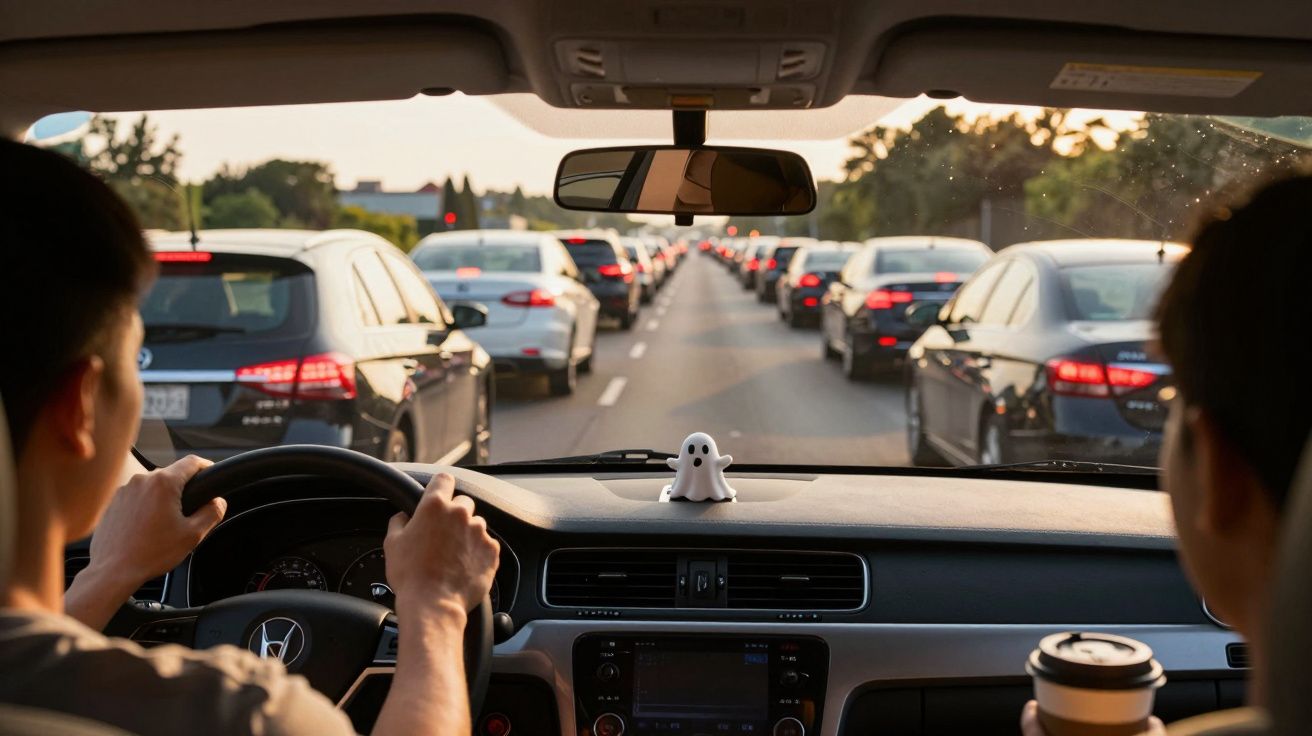
Wipers slide across dusty windshields, the radio hums, kids fidget in the backseat. In the left lane, a white SUV inches forward half a car length and your fingers tighten on the steering wheel. You glance in the mirror, look over your shoulder, and slip across the broken white line with a small jolt of defiance. For three glorious seconds, you’re “winning.” Then everything stops again.
Two minutes later, your old lane surges ahead while you sit stuck between a delivery van and a tired-looking hatchback. The driver you just cut off creeps past you, avoiding eye contact. Your pulse is up, you’re no closer to home, and somehow the whole jam feels angrier than before. You wonder if there’s a trick you’re missing-or if the real problem is a little closer to your right foot.
Why lane-hopping in traffic jams almost never pays off
Watch any freeway from an overpass and you’ll notice a strange choreography. One lane seems faster, then the next, then everything freezes like a game glitching in slow motion. From above, you can see what you never see behind the wheel: nobody is really “winning.” They’re just trading places in the same long, slow line.
On the ground, though, it feels very different. You stare at the car next to you, track its progress, and every tiny gain stings. Your brain quietly turns it into a race against random strangers. So you change lanes, chasing a few yards of imaginary advantage. Most of the time, you don’t gain anything you can actually measure. What you do gain is stress-and a slightly more chaotic traffic flow around you.
There’s a name for the slowdowns that seem to appear out of nowhere: phantom traffic jams. No crash, no construction, no obvious cause. One driver brakes a little harder than necessary. The car behind taps the brakes a fraction more. That ripple moves backward through traffic like a wave, turning into a complete stop hundreds of yards behind the original moment. Researchers in Japan recreated this effect on a circular track with 22 cars driving at a constant speed. Within minutes, a stop-and-go wave appeared out of thin air, as if the road itself were breathing. Lane changes add small shocks to this fragile system, multiplying those waves.
Mathematicians who model traffic treat cars like particles in a fluid. When everyone keeps roughly the same speed and following distance, the “flow” stays stable. Random braking, tight gaps, and sudden lane changes act like rocks tossed into a river. Each move looks small from inside your own car. From the system’s point of view, you’re creating turbulence. And that turbulence doesn’t just affect you-it hits the drivers behind you, and the drivers behind them, snowballing into a jam you’ll later complain about online.
How to drive in jams without fueling “phantom traffic”
There’s a small, boring move that turns you into the quiet hero of a traffic jam: leave a bigger gap than feels natural and keep your speed steady and gentle. It looks like you’re inviting people to cut in. In reality, you’re acting like a shock absorber for the line behind you, smoothing every tiny brake tap into a softer, slower wave.
The technique is simple. Pick a landmark ahead-a sign, a bridge, a tree. When the car in front passes it, count “one-thousand, two-thousand” before you reach the same point. If you can keep that two-second gap, you’re already doing better than most of the line. Let your speed fall naturally instead of stabbing the brakes. Use your accelerator like a volume knob, not a light switch. You’ll see the car ahead stop-and-go, while you roll more evenly. That’s how you quietly kill phantom waves.
On a bad day, this feels almost impossible. You’re late, your boss is texting, your kid’s school closes in twenty minutes. On top of that, drivers dive into the space you left. It feels like an insult. This is where the real work is: staying calm enough to keep your rhythm anyway. On a purely selfish level, smoother driving is easier on your nerves and your fuel bill. Let’s be honest: nobody does this perfectly every day. But on the days you manage it, the drive genuinely feels less like a fight and more like weather you’re moving through.
Listening to traffic experts, you hear the same point again and again.
“The safest, fastest traffic is rarely the one that feels fast in the moment; it’s the one where nobody feels the urge to fight for a better spot,” explains a traffic engineer I spoke with who has spent twenty years studying freeway patterns.
It’s not about becoming a saint in the slow lane. It’s about avoiding specific high-risk habits that feed phantom jams and crumpled metal: darting into tiny gaps, riding someone’s bumper because “they should go faster,” or watching the next lane more than you watch your own speed. A few simple reminders help:
- Wait at least 15–20 seconds before deciding your lane is “worse.”
- Only change lanes when you can maintain your speed-not to stop sooner in a different spot.
- Ask, “Will this surprise someone?” If yes, don’t do it.
Driving with the phantom in mind
Once you start noticing phantom traffic, it’s hard to unsee. That sudden wall of brake lights on an empty stretch of highway. The jam that disappears at the top of a hill. The way everyone surges and stalls in a frustrated chorus. You start to realize that much of what feels like “bad luck” is actually thousands of tiny human decisions colliding with physics.
This doesn’t mean you never change lanes again. It means you choose your moments with a different question in mind: “Am I following the flow, or stabbing at it?” A calm, well-signaled move into a lane that’s genuinely moving more steadily can make sense. But hopping across three lanes because you’re convinced freedom is one strip of asphalt away usually leaves you right where you started-with a slightly faster heartbeat.
On a screen, traffic models look clean and almost beautiful. On the road, traffic is messy, sweaty, emotional: one horn, one angry gesture, one impatient swerve; one exhausted parent distracted by a crying toddler. All of that feeds those ghostly waves pulsing along the pavement. We can’t control the weather, the construction, or the broken-down truck around the bend. But we can control-at least partly-how much chaos we inject into the shared space between those red taillights. The next time you’re tempted to dart into a “faster” lane, you might catch yourself pausing for half a second. Sometimes that small pause is where the whole story changes.
| Key point | Detail | Why it matters to the reader |
|---|---|---|
| Phantom traffic jams | Stop-and-go waves form from small braking events, with no visible cause | Helps explain why jams appear “out of nowhere” and feel so frustrating |
| The lane-changing myth | Frequent lane-hopping rarely saves meaningful time and disrupts flow | Encourages drivers to drop a useless habit that increases stress and risk |
| Smoother driving | Larger gaps and gentle speed changes absorb shocks in traffic flow | Offers a concrete way to make trips calmer, safer, and often just as fast |
FAQ
- Does changing lanes in a jam ever really save time? Occasionally you might gain a minute or two on a long drive, but on typical urban commutes, studies show the average gain is tiny and often canceled out by added stress and risk.
- Why does the other lane always look faster than mine? Your brain notices every car that passes you and mostly ignores the ones you pass, creating a strong illusion that you’re always in the “wrong” lane.
- Is staying in one lane always the best strategy? Not always, but in general, choosing a lane early, sticking with it, and focusing on smooth driving gets you almost the same arrival time as aggressive lane-changing-with fewer close calls.
- What’s the safest way to change lanes in heavy traffic? Signal early, check mirrors and blind spots, move gradually, and only change if you can keep roughly the same speed without forcing others to brake.
- Can individual drivers really reduce phantom traffic? Yes. One car driving smoothly with a larger gap can dampen stop-and-go waves behind it, making the jam less severe for dozens of drivers you’ll never even see.



Comments
No comments yet. Be the first to comment!
Leave a Comment