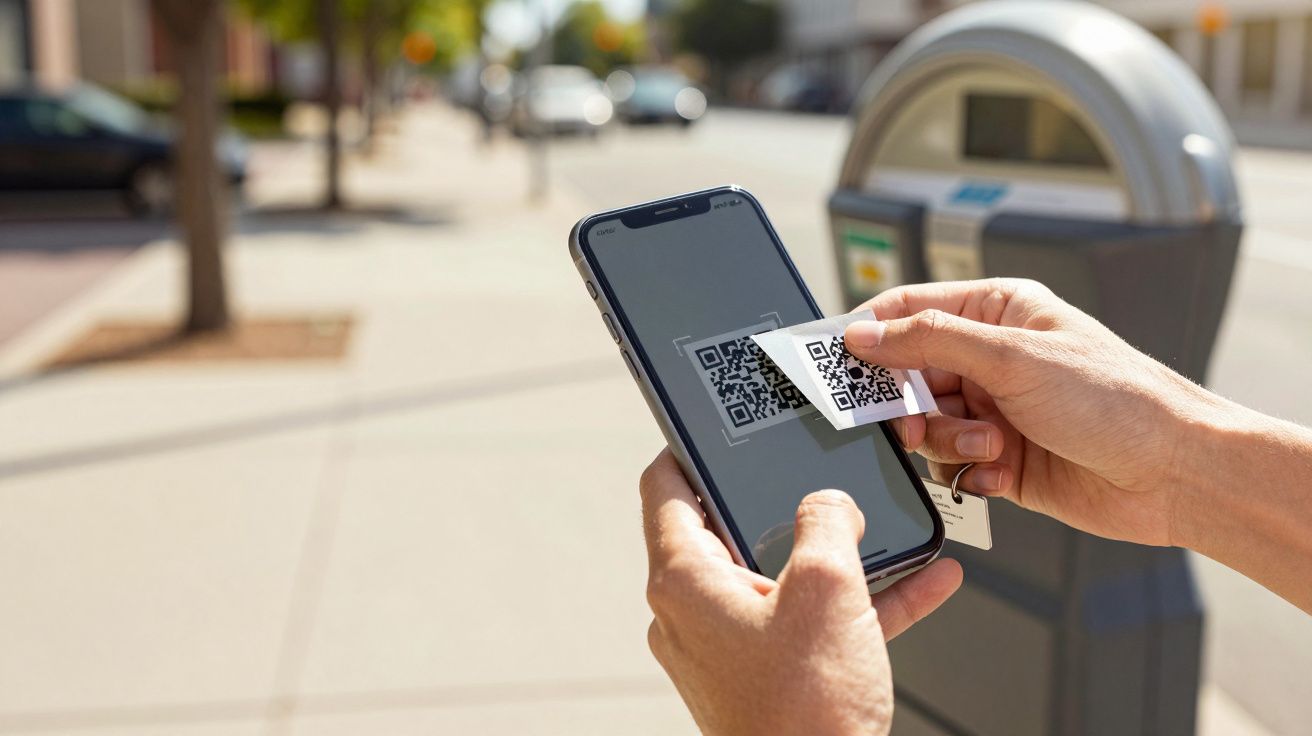
The man in the navy suit is already late. He jumps out of his car, phone in hand, scanning the QR code on the parking meter without even looking at the screen. Two taps, a false sense of relief, and he hurries toward the glass office tower.
An hour later, his bank sends an alert: three online payments he doesn’t recognize. The “parking app” he used isn’t from the city. It’s a scam payment form on a cloned website, triggered by a QR code sticker that looks almost identical to the real one.
No security warning. No flashing red pop-up.
Just a quiet leak of money, hidden under a small square of black-and-white pixels.
How QR Code Parking Went From Clever Convenience to a Quiet Trap
Scan, pay, go. That’s the promise posted on thousands of parking meters on busy streets. No coins, no waiting at machines that never read your card on the first try. You pull out your phone, scan the code, and feel strangely efficient.
That everyday reflex is exactly what scammers are counting on.
They’re not hacking meters with laptops in the dark. They’re doing something much simpler: printing their own QR stickers and pasting them neatly over the official ones.
In several U.S. cities, police have warned drivers about fake QR codes stuck on meters and pay stations. In Texas, reports described people being redirected to a polished-looking website that asked for card details “to pay for parking.” The payment went through. The parking session never did.
On Reddit and local Facebook groups, the stories look eerily similar: a busy parking lot, a new QR sticker that “looks more modern,” and a site that mirrors real parking pages right down to the logo and color palette. By the time victims notice unexplained charges, the scammers’ site is offline-ready to be replaced by another.
The trick works because QR codes feel neutral and boring. We treat them like barcodes, not like clickable links. But that’s exactly what they are: shortcuts straight into the wild west of the internet.
When you scan, your phone decodes a URL and quietly hands it to your browser. You often don’t check the address bar-especially in bright sun, with bags in your hands and a meeting in five minutes.
Scammers understand this micro-moment of pressure. They know that at a meter, you’re not in “security mode.” You’re in “just let me park and get out of here” mode. It’s a tiny shift in mindset, and that’s where they slip in.
How to Safely Use QR Codes on Parking Meters Without Giving Them Up
There’s one simple habit that changes everything: read the URL that pops up before you tap. Not the whole thing like a lawyer-just the core: the domain name.
Is it the city’s official site? The real parking operator? Or some random mix of words and numbers you’ve never seen?
If your phone lets you preview the link (most camera apps do), pause for two seconds. That tiny pause is your best street-level firewall.
City parking is usually predictable. Signs often list the official app name, a short code to text, or a .gov / well-known company domain. If the QR code sends you somewhere that doesn’t match, treat it as a red flag.
Practically speaking, it helps to download the official parking app once-at home or in the car-and stick with it. Search for it in the app store instead of trusting whatever a sticker sends you to.
Let’s be honest: nobody actually does this perfectly every day. You’re rushing, kids are in the back seat, your boss is texting you. Still, having the app already installed removes one stressful decision on the street.
One more defensive move: look at the QR code sticker itself. Is it slightly crooked? Shiny when the rest of the meter is matte? Are the edges lifting when you run a fingernail around it? Those small signs often mean someone simply slapped a sticker over the original.
If anything feels off, skip that code and pay another way-even if it’s annoying. That extra minute is cheaper than canceling a bank card and chasing refunds for days.
“The best scam is the one that looks like the normal way of doing things,” a cybersecurity expert told me. “Criminals don’t need to be technically brilliant. They just need you to be in a hurry.”
- Check the domain first - if it doesn’t match the operator on the sign, stop.
- Use the official app or website you found yourself, not the one handed to you by a sticker.
- Trust discomfort - a crooked label, a too-good-to-be-true “new system,” or a meter that suddenly “only works by QR” all deserve a second look.
- Pay with a credit card or a virtual card when you can, not direct debit from your bank account.
- Screenshot weird pages - they’re useful if you later report a scam to the city or your bank.
Rethinking the Tiny Moments When We Give Away Our Data
We tap our cards at coffee shops. We let apps track our location. We scan mystery codes to view restaurant menus or connect to Wi-Fi. On a good day, it all feels like progress: no coins, no paper, no hassle.
On a bad day, it feels like we’ve turned everyday gestures into betting chips.
The parking meter scam sits right in the middle of that tension. It’s too minor to feel dramatic, yet close enough to your bank account to leave a real bruise.
On a human level, losing money is only part of the story. People talk about the shame of “falling for it,” as if being fooled by a well-made sticker says something about their intelligence. It doesn’t.
Those QR codes are designed for frictionless use, not careful inspection. The whole system favors speed over thought. When you slip, you’re behaving exactly as the designers intended. The only difference is who’s behind the design that day: the city, or a scammer with a printer and a glue stick.
On a more hopeful note, habits travel. The small reflex you build at a parking meter-glancing at the URL, trusting that tiny prickle of doubt-follows you elsewhere: into online shopping, into late-night “update your delivery details” emails.
On a crowded street, juggling bags and schedules, it’s easy to feel powerless against invisible fraudsters. But that’s not the full picture. You don’t need to become paranoid or give up QR codes entirely. You just need one or two simple, street-smart reactions that fit real life.
On a busy Tuesday under a gray sky, that could be the difference between an ordinary parking payment and a week spent on the phone with your bank.
| Key Point | Detail | Why It Matters to You |
|---|---|---|
| QR codes can be replaced with fake stickers | Scammers print and paste their own codes over real parking meter labels | Helps you see meters as potential fraud targets, not neutral objects |
| Reading the URL is your fastest defense | A two-second look at the domain often exposes fake sites | Gives you a simple, realistic habit that prevents most QR scams |
| Use official apps and safer payment methods | Installing the real app and using credit/virtual cards can limit damage | Lowers financial risk and reduces hassle if something goes wrong |
FAQ
- How do I spot a fake QR code on a parking meter? Look for stickers that are slightly misaligned, peeling at the edges, or covering another label. Then scan mentally, not just physically: if the website address looks strange or doesn’t match the operator named on the meter, back out.
- Is it safer to avoid QR codes altogether? You don’t have to. Using them with a quick URL check and sticking to official apps or bookmarked sites keeps the risk low enough for everyday life.
- What should I do if I paid through a fake QR code? Contact your bank immediately, cancel or freeze the card you used, and report the transaction as fraud. Take photos of the meter and sticker and send them to the local parking authority or city government.
- Are some payment methods less risky than others? Credit cards and virtual cards usually offer better chargeback and fraud protection than direct debit from your bank account. Using an official app with stored details is often safer than entering your card into a random browser form.
- Can QR codes themselves be “infected” with viruses? A QR code is just a way to encode a link or text. The danger comes from where the link leads. Malicious sites can try to trick you into installing apps or entering sensitive data, which is why that brief moment of checking the URL matters so much.





Comments
No comments yet. Be the first to comment!
Leave a Comment