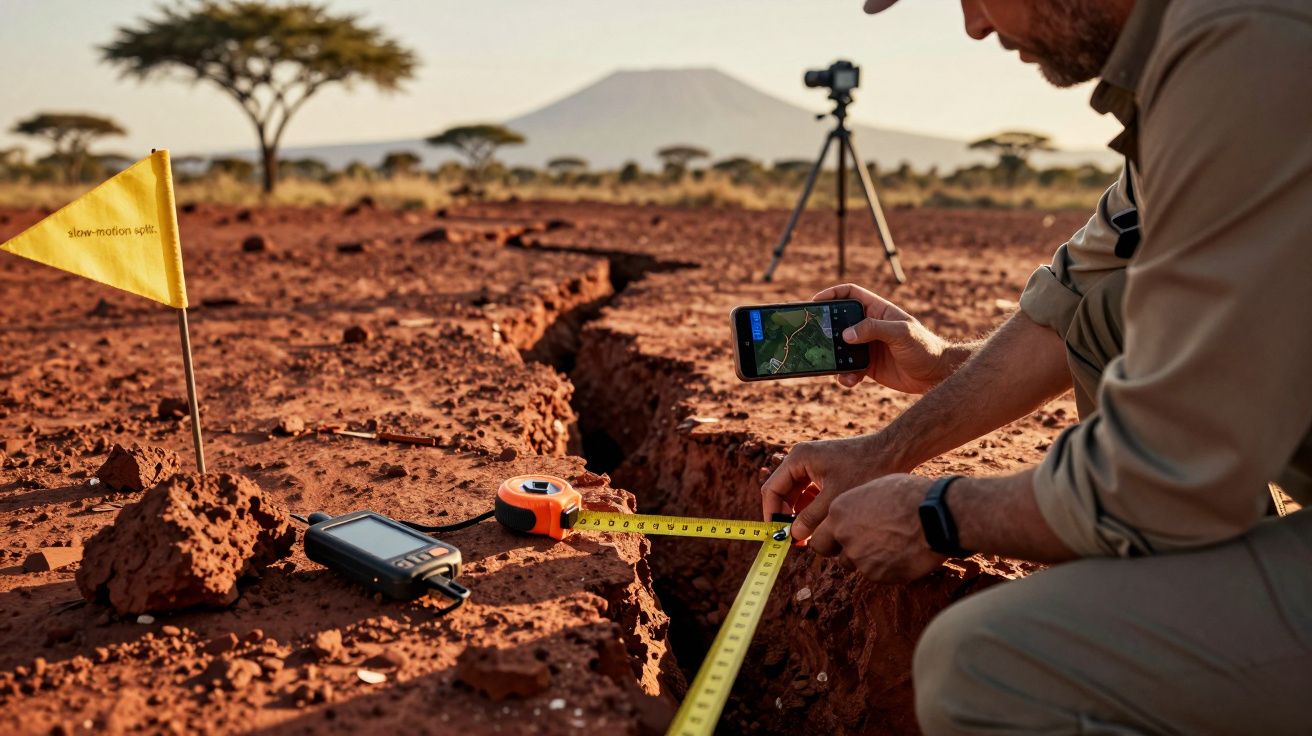
Dust hangs in the air, goats skirt the edges, and a group of kids in flip-flops lean dangerously close, peering into something that shouldn’t be there. A jagged trench, several kilometers long, has sliced through farmers’ fields in southern Kenya, like the earth itself has yawned mid-sentence.
A few meters away, a scientist kneels with a GPS receiver in her hands, quietly watching the numbers shift on the tiny screen. She’s not looking for buried treasure. She’s tracking a continent that’s very slowly tearing itself apart. Africa-the huge solid shape you know from classroom maps-is moving in two different directions at once.
Somewhere far in the future, that crack could fill with a brand-new ocean. And the videos we scroll past today might be the first chapter of that story.
Africa Is Splitting in Slow Motion - and Cameras Are Finally Catching It
On Google Maps, the Great Rift Valley looks like a scar. On the ground, it feels more like a promise. The African continent is sitting on not one but several tectonic plates, and along a long, curving line from Ethiopia down to Mozambique, those plates are quietly drifting apart.
The process has a name: the East African Rift System. Scientists say parts of eastern Africa are moving away from the rest of the continent by a few millimeters a year. It’s a pace you’d never notice with the naked eye, yet over millions of years, it’s enough to redraw the world map.
We tend to think of continents as fixed, like puzzle pieces glued in place. The Rift is a reminder that the puzzle is still being shaken.
The story hit global headlines in 2018, when dramatic photos and shaky phone videos from southwestern Kenya went viral. A huge crack, in some spots more than 15 meters deep and several meters wide, opened across a busy road near Mai Mahiu after heavy rain. Cars were stranded. A family home partly collapsed. People filmed as chunks of asphalt simply dropped away.
For locals, it wasn’t a geology lesson-it was a disruption. Farmers watched their fields split. Drivers were rerouted overnight. One widely shared clip showed a woman stepping carefully across a new gap where, a day earlier, she had walked without thinking. On a human timescale, it felt like the ground had betrayed them.
Geologists later explained that existing faults were being exposed and widened, not suddenly created from nothing. Still, those raw smartphone videos gave the world a rare, almost intimate glimpse of a continental breakup in progress.
Behind the visuals lies a slow, relentless engine. Africa straddles two major tectonic plates: the Nubian Plate to the west and the Somali Plate to the east. Deep beneath East Africa, hot mantle rock is rising upward, weakening the crust above. As that material pushes and stretches, the surface fractures into long faults and sunken valleys.
Over geological time, those small movements accumulate. GPS stations anchored into the ground in Ethiopia, Kenya, and Tanzania show measurable drift: eastern Africa sliding slightly southeast, the rest of the continent more stable. Think of it like a hairline crack in a windshield that, given enough heat and vibration, slowly creeps farther each year.
If the rifting continues, the Somali Plate will eventually peel away, taking parts of Ethiopia, Kenya, Tanzania, and Mozambique with it. Between the two landmasses, a new ocean basin could open, flooding in from the Red Sea and the Indian Ocean. On maps millions of years from now, East Africa could look more like a large island.
How Scientists Track a Future Ocean - From Satellites to Viral Clips
From the outside, it can feel like scientists are guessing about a future none of us will see. In reality, they’re obsessed with measurements. On hillsides across East Africa, small metal boxes quietly record ground motion, communicating with satellites that orbit hundreds of kilometers overhead. Each packet of data shows how far a point has shifted, down to a few millimeters.
Researchers then stitch this into time-lapse maps of the continent slowly stretching. They compare that with earthquake records and with the chemistry of volcanic rocks in places like Ethiopia’s Afar region. The result is a kind of X-ray video of Africa’s interior, played back in slow motion instead of real time.
The viral crack videos from Kenya and Ethiopia fit into this picture as real-world checkpoints. They show where the stress is reaching the surface-where theory meets pavement and farmland.
On a bad day, a video of the ground splitting can look like the trailer for an apocalypse movie. It taps into something primal. We rely on the ground being the one thing that doesn’t fail. On a more practical level, people living along the Rift worry about what the science means for them in the next decade, not in ten million years.
Engineers are already having to adapt. Roads and pipelines that cross known fault zones in Kenya and Ethiopia need flexibility built in. Power lines that serve growing cities like Nairobi and Addis Ababa are being planned with landslides, subsidence, and earthquakes in mind-not just distance and cost. On a spreadsheet, it’s “infrastructure resilience”; on the street, it’s whether the road to the hospital holds up after the next heavy rain.
And then there’s tourism. The same forces that are tearing the continent apart have carved dramatic cliffs, hot springs, and volcanic lakes. The Rift Valley viewpoint outside Nairobi is crowded most weekends, as people pose for photos over a landscape slowly reshaping under their feet.
“We’re not watching a disaster, we’re watching plate tectonics doing what they’ve always done,” says Kenyan geologist Jacqueline Afullo, who maps active faults outside Nairobi. “The question is how we live with that, not how we stop it.”
- Some rift-related cracks are shallow features triggered by heavy rain and erosion, even if they align with deep tectonic faults.
- The new ocean, if it forms, will take at least 5 to 10 million years-no one alive today will see Africa fully split.
- Videos from Kenya and Ethiopia are valuable to researchers, but they sit alongside decades of satellite data, field surveys, and seismic records.
What a New Ocean Would Mean - and What It Doesn’t
Think about a coastline you know well, even from photos: the jagged fjords of Norway, the long beaches of the Indian Ocean, the red cliffs of South Africa. None of those shapes are permanent. They’re snapshots in a very long slideshow. The hypothetical “East African Ocean” would just be the next frame, slowly flooding into a depressed valley much like the Red Sea did tens of millions of years ago.
For future humans, that could mean new ports, new sea routes, and a very different political map. Parts of Ethiopia that are now landlocked might one day have direct access to water, while inland communities today could end up near a distant shoreline. It’s a strange feeling to realize that today’s arguments over borders, pipelines, and trade routes are all happening on a surface that won’t stay put forever.
We’ve all lived that moment where a news alert sounds huge, almost existential, but your own street looks exactly the same. The Africa-splitting story sits in that tension: real, profound, yet almost painfully slow on our scale.
There’s also a more personal layer that rarely makes the headlines. Families farming along the Rift don’t talk about “continental breakup”; they talk about cracked walls, shifting wells, and when the next small quake will rattle the dishes. Scientists often rely on these everyday observations, noting where a house sank slightly, or where a borehole suddenly ran dry after a tremor.
Let’s be honest: nobody reads detailed scientific papers every day about plate tectonics. Most people encounter this topic in 30-second clips on TikTok or a post showing a scary crack in a highway. That’s where misunderstandings creep in-from “Africa is splitting in half next year” to “this proves the world is ending.”
For researchers, one quiet job is storytelling. They have to keep repeating: yes, Africa is slowly breaking along the Rift; no, it’s not going to fall apart like a movie set. The more clearly the long timescale is explained, the easier it becomes for communities and planners to focus on the real near-term issues: earthquakes, landslides, subsiding buildings, and volcanic hazards.
Behind every viral video, there’s usually a local official figuring out how to reroute traffic by tonight, an engineer inspecting a bridge, and a scientist mentally adding a new data point to a map of moving plates. That mix of daily improvisation and deep time is the real story of a continent that never truly stands still.
| Key point | Details | Why it matters to readers |
|---|---|---|
| The split is real but incredibly slow | GPS and satellite data show parts of East Africa drifting a few millimeters per year along the East African Rift System. At this pace, a full ocean basin needs millions of years to form. | Helps cut through doomsday headlines: your lifetime won’t include Africa snapping in two, but you may feel small quakes or see cracks linked to the same forces. |
| Viral crack videos show surface effects, not the whole story | Clips from Kenya and Ethiopia often capture shallow collapses where rain, erosion, and hidden faults interact. Geologists use them alongside deep seismic and satellite records. | Encourages a critical eye when watching dramatic footage online and explains why a single video can’t “prove” a continent is suddenly breaking apart. |
| Living and building on the Rift needs extra care | Roads, pipelines, and housing across Rift zones are increasingly designed with flexible foundations, alternate routes, and better monitoring for ground movement. | Whether you live in Africa or plan to visit, this affects safety, insurance, travel routes, and long-term investment in fast-growing Rift Valley cities. |
FAQ
- Is Africa really splitting into two separate continents? Yes, in geological terms. The East African Rift marks a boundary where the Somali Plate is slowly moving away from the Nubian Plate, which will eventually create a distinct eastern landmass separated by an ocean. This process unfolds over millions of years, not human lifetimes.
- Will people alive today see a new ocean form in East Africa? No. The rifting is measurable today, but the transition from valleys and lakes to a true ocean basin typically takes at least 5 to 10 million years. What people might experience instead are more modest effects like minor earthquakes, ground subsidence, and changes in local landscapes.
- Did the huge cracks in Kenya suddenly appear out of nowhere? Not exactly. Those dramatic trenches usually occur where existing faults, loose sediments, and heavy rain combine. The tectonic stress is long-term, but intense storms can trigger sudden collapses that expose deep fractures and make it look like the ground opened overnight.
- Is the splitting of Africa linked to more earthquakes and volcanoes? Rift zones are naturally associated with seismic activity and volcanism, and East Africa is no exception. Countries such as Ethiopia, Kenya, and Tanzania already monitor active volcanoes and faults, and many of the region’s lakes and hot springs exist because magma and faults sit close to the surface.
- Should people living in the Rift Valley be worried about a catastrophic breakup? They need to think in terms of everyday risk, not continent-scale disaster. The genuine concerns are building codes, landslide-prone slopes, flood management, and earthquake preparedness. Long-term continental drift shapes the background, but local planning makes the real difference to safety.
Stand at the edge of a Rift Valley escarpment at sunset and the science suddenly feels very personal. The air thins out, the land drops away, and your eye follows a line of hazy hills that stretches farther than your own lifetime will ever reach. Somewhere along that line, plates are sliding, rocks are stretching, and a future coastline is being drafted in silence.
Our species arrived long after this process began, and it will continue long after the last news alert about “Africa splitting” fades from your phone. That doesn’t make the story distant. It’s built into where cities grow, how roads crack, why lakes sit exactly where they do. Every viral video of a new fissure is like a postcard from the deep past and deep future, mailed to the present.
Sharing those clips, talking about the Rift with friends, or just zooming in on satellite images for a few minutes is a way of stepping back from the everyday rush. It’s a reminder that the ground under our feet has its own slow agenda. Somewhere, without noise or haste, a new ocean is rehearsing its entrance-and we’re lucky enough to be here for the early scenes.






Comments
No comments yet. Be the first to comment!
Leave a Comment